- L’actualité B2B
- Tout
- Acquisition
- Actualités corporate
- Anniversaires
- Awards / récompenses
- Bureau / Office
- CHR/HORECA
- Communication / Marketing des entreprises
- Distribution
- e-commerce
- Événements
- Industrie
- L'actu des salons professionnels
- L'actu Hôtellerie
- L'actualité des filières
- L'actualité RSE des entreprises
- Les grandes interviews
- Nominations
- Packaging
- Resultats financiers
- Retail - Actualité boutiques
- Retail - Actualité des grandes enseignes
- RSE / Économie circulaire
- Made in France
- HFN – Le Magazine
- International content






- L’actualité B2B
- Tout
- Acquisition
- Actualités corporate
- Anniversaires
- Awards / récompenses
- Bureau / Office
- CHR/HORECA
- Communication / Marketing des entreprises
- Distribution
- e-commerce
- Événements
- Industrie
- L'actu des salons professionnels
- L'actu Hôtellerie
- L'actualité des filières
- L'actualité RSE des entreprises
- Les grandes interviews
- Nominations
- Packaging
- Resultats financiers
- Retail - Actualité boutiques
- Retail - Actualité des grandes enseignes
- RSE / Économie circulaire
- Made in France
- HFN – Le Magazine
- International content
CSR news from the business world
Corporate social responsibility is no longer a posture but a deep-rooted movement, driven on a daily basis by concrete actions, structuring choices and a long-term vision. From eco-design to certification processes, from the sharing of expertise to collective mobilisation, initiatives are multiplying and reflect a shared conviction: CSR is built over time, patiently, through consistency and commitment. An overview of recent developments which, each in their own way, embody this dynamic.
Systemic eco-design: Peugeot frères industrie structures a more robust industrial model
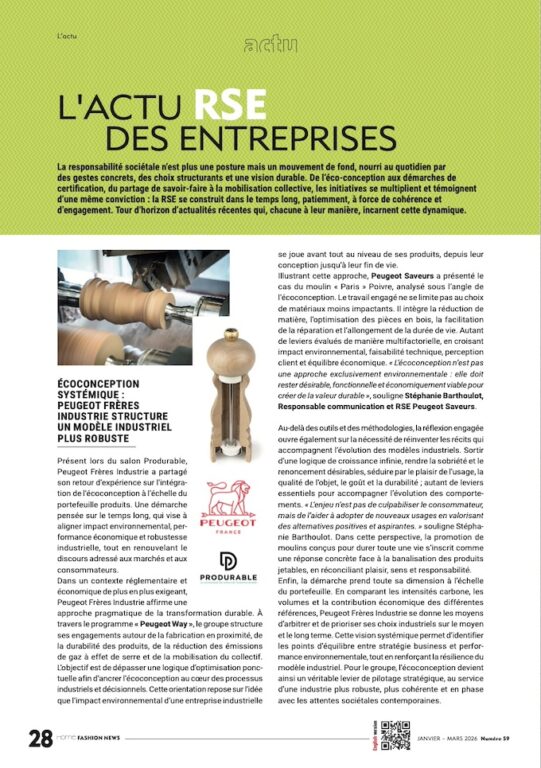
Present at the Produrable trade show, Peugeot Frères Industrie shared feedback on integrating eco-design across its entire product portfolio. Conceived as a long-term approach, this initiative aims to align environmental impact, economic performance and industrial robustness, while renewing the narrative addressed to markets and consumers alike. In an increasingly demanding regulatory and economic environment, Peugeot Frères Industrie asserts a pragmatic approach to sustainable transformation. Through the “Peugeot Way” programme, the group structures its commitments around local manufacturing, product durability, the reduction of greenhouse gas emissions and collective mobilisation. The objective is to move beyond a logic of isolated optimisation and firmly anchor eco-design at the heart of industrial and decision-making processes. This orientation is based on the conviction that the environmental impact of an industrial company is primarily determined by its products, from design through to end of life. Illustrating this approach, Peugeot Saveurs presented the case of the Paris pepper mill, analysed through the lens of eco-design. The work undertaken goes far beyond the selection of lower-impact materials. It includes material reduction, optimisation of wooden components, easier repair and extended product lifespan. These levers are assessed using a multifactorial approach that combines environmental impact, technical feasibility, customer perception and economic balance. “Eco-design is not an exclusively environmental approach: it must remain desirable, functional and economically viable in order to create lasting value,” emphasises Stéphanie Barthoulot, Head of Communication and CSR at Peugeot Saveurs.
Beyond tools and methodologies, this reflection also highlights the need to reinvent the narratives that accompany changes in industrial models. Moving away from a logic of infinite growth, making sobriety and restraint desirable, and appealing through pleasure of use, object quality, taste and durability are all essential levers to support behavioural change. “The challenge is not to make consumers feel guilty, but to help them adopt new uses by promoting positive and aspirational alternatives,” Stéphanie Barthoulot notes. From this perspective, promoting mills designed to last a lifetime stands as a concrete response to the trivialisation of disposable products, reconciling pleasure, meaning and responsibility. Finally, the approach takes on its full dimension at portfolio level. By comparing carbon intensities, volumes and the economic contribution of different product lines, Peugeot Frères Industrie equips itself to arbitrate and prioritise its industrial choices over the medium and long term. This systemic vision makes it possible to identify points of balance between business strategy and environmental performance, while strengthening the resilience of the industrial model. For the group, eco-design thus becomes a genuine lever for strategic steering, serving a more robust, more coherent industry aligned with contemporary societal expectations.
COP30 climate: Francéclat’s report on a pivotal yet contrasted conference
Francéclat presents an analytical report on COP30 (Brazil, 2025), held ten years after the Paris Agreement. The conference took place against a tense geopolitical backdrop, marked by the absence of the United States, the strengthening of the BRICS bloc and the strong presence of several hydrocarbon-producing countries, while the most vulnerable nations were calling for concrete commitments on climate adaptation financing. Bringing together more than 200 States party to the United Nations Framework Convention on Climate Change, along with observers from local authorities, businesses, NGOs and the scientific community, COP30 set out to translate existing commitments into operational tools. Presented by the Brazilian presidency as the “COP of implementation”, it was expected in particular to clarify pathways to limit global warming to 1.5°C, accelerate the energy transition and consolidate a new collective climate finance target, set at USD 300 billion per year from 2035. Following difficult negotiations, COP30 concluded with a “Mutirão decision”, described by many observers as an imperfect compromise. While a tripling of adaptation finance was agreed in principle, its implementation was postponed until 2035, with no precise timetable. No binding commitments were made on phasing out fossil fuels, and the first adaptation indicators adopted were deemed insufficiently robust by several States, with their revision already deferred to 2026. Alongside intergovernmental decisions, the Global Climate Action Agenda—detailed in a report published by the UNFCCC in November 2025—highlights the growing role of non-state actors. It lists voluntary commitments by cities, companies and investors across key areas such as power grids, a just transition, the use of artificial intelligence in support of climate action, and ocean protection.
Cassina strengthens its csr strategy
Cassina has published its fourth sustainability report, confirming a proactive approach to transparency regarding its environmental, social and governance performance. This edition structures its commitments around four pillars: the brand’s vision and values, the product, people and the planet. For the first time, the report also incorporates the Haworth Lifestyle Design Division—bringing together Cassina, Karakter, Zanotta and Cappellini under the leadership of Luca Fuso—along with dedicated appendices for Zanotta and Cappellini. On the product side, Cassina continues to roll out a conscious design approach, integrating principles of circularity from the earliest stages of design, without compromising on aesthetics or comfort. In 2024, the use of recycled materials and bio-based foams became standard in upholstered products, while full or partial disassembly has continued to progress. This approach is supported by an internal circularity tool, aligned with ISO 59000 standards and independently verified, enabling precise assessment of end-of-life scenarios. Patricia Urquiola’s Dudet models and the new edition of Carlo Scarpa’s Cornaro exemplify this commitment through their recyclability and fully demountable design. The human dimension remains central. Cassina was awarded the Top Employers certification in 2024 and 2025, recognising the quality of its HR strategy, and launched its first “Quality Week”, an internal training programme dedicated to materials and manufacturing excellence. Finally, the brand is pursuing ambitious environmental commitments: 100% renewable electricity across its production sites by 2025, emissions reductions validated by the Science Based Targets initiative, and an ambition of zero waste to landfill across all sites. A trajectory that confirms Cassina’s determination to embed sustainability at the heart of all its industrial and creative decisions.
Eurokera awarded at the 2025 Grand Prix de la marque engagée
EuroKera was awarded the Bronze B2B Prize at the 2025 Grand Prix de la Marque Engagée for its “Slim” cooking surface, at a ceremony held in October 2025 by LinkUp and Produrable. This award, dedicated to initiatives that measurably integrate environmental, social and societal challenges, recognises the group’s commitment to responsible innovation. Developed in glass-ceramic, the “Slim” technology reduces the weight and thickness of cooking surfaces by 20%, thereby limiting raw material use, energy consumption and CO₂ emissions during manufacturing, while maintaining performance equivalent to standard cooktops. An approach that illustrates EuroKera’s strategy of rethinking material design in order to reduce its carbon footprint across the entire product life cycle.
James Dyson Award
The 2025 edition of the James Dyson Award recognises two innovations from the international student design community, each receiving £30,000 to support their development. The winning projects were praised for their ability to address major environmental and societal challenges. Designed by Filip Budny, a PhD candidate in nanotechnology at the Warsaw University of Technology, WaterSense is a continuous water quality monitoring sensor. Made from recyclable paper and powered by a hydro-generator, the device relies on an artificial intelligence platform capable of detecting pollution in real time and anticipating risks up to 72 hours in advance. The second prize was awarded to Alessandra Galli, an Italian designer and graduate of Delft University of Technology, for OnCue, a connected keyboard incorporating vibrations and light signals to help people with Parkinson’s disease maintain a regular typing rhythm. Adaptable to each user, the device improves digital comfort and everyday autonomy. Since 2002, the James Dyson Award has recognised more than 400 young inventors worldwide, reaffirming the James Dyson Foundation’s commitment to engineering that serves progress and responsible innovation.
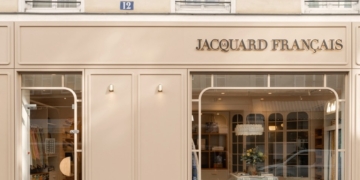
Le Jacquard Français
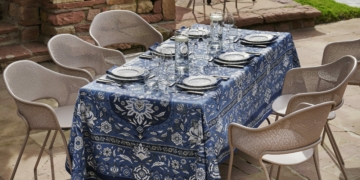
With the Dune collection, Le Jacquard Français affirms a CSR-driven approach rooted in the product itself, demonstrating that environmental responsibility can enrich aesthetics as much as meaning. Inspired by desert landscapes and ancestral know-how, this Spring–Summer 2026 line offers a committed vision of home textiles, where material becomes a genuine lever for sustainable transformation. Conceived as a sensitive evocation of the South and North Africa, the collection draws on references ranging from shepherds’ tents and tadelakt architecture to the play of light across dunes. Beyond inspiration, Dune stands out for its concrete and measurable CSR commitments. The collection incorporates 61% “Re-Fil” yarns, made from the recovery of the Maison’s own production offcuts. Embedded within the “We Do Care” charter, this circular approach reflects a determination to rethink materials from the outset, reduce waste and give existing resources a second life—placing eco-design at the heart of product development without compromising on quality or aesthetic standards. Woven in the brand’s Vosges-based manufacture, the collection extends a recognised jacquard expertise, while the choice of yarn-dyed woven fabric ensures an authentic, long-lasting finish designed to stand the test of time.
This vision will take shape at Maison&Objet, where Le Jacquard Français will present its new collections on its stand in Hall 6, as well as within the “Manufactures d’excellence” space—an installation dedicated to France’s finest heritage crafts in the service of the Contract sector, developed in partnership with the Réseau Excellence of the National Association of Living Heritage Companies. The brand will also feature a bespoke bed linen set in the “What’s New? In Hospitality” area. During Paris Déco Home, Le Jacquard Français will unfold a three-part presence. A new boutique at 28 rue Bonaparte, included in the official visitor route, will embody the Maison’s contemporary retail vision, combining experience, product storytelling and the celebration of craftsmanship. The brand will also take over the outdoor savoir-faire space with an oversized armchair upholstered in the Promenade impériale design (SS 2026 collection). Finally, it will take part in a photographic exhibition organised by Yellow Korner, dedicated to handwork and manufacturing gestures.
Table & nature, a key player in the ecological transition
Table & Nature welcomed Mathieu Lefevre, Minister Delegate for the Ecological Transition, towards the end of the year for a visit focused on innovation and sustainable tableware. The meeting provided an opportunity to present the company’s work on its range of plant-based tableware made from PLA, a petroleum-free bioplastic designed to reduce the environmental and health impact of everyday use. Through this exchange, the young company highlighted an approach centred on product durability and controlled end-of-life management. Its products are designed to be easily recyclable, to avoid water pollution and to be biodegradable in industrial environments—marking a clear break from conventional plastics. This approach aligns performance in use with environmental responsibility. The minister’s visit to a French start-up pioneering biomaterials reflects a strong political will to support initiatives that reconcile innovation, ecological transition and industrial autonomy. The announcement of PLA production arriving in France by 2027 opens up new prospects for the sector—prospects to which Table & Nature fully intends to contribute.
Source: Home Fashion News January26