- L’actualité B2B
- Tout
- Acquisition
- Actualités corporate
- Anniversaires
- Awards / récompenses
- Bureau / Office
- CHR/HORECA
- Communication / Marketing des entreprises
- Distribution
- e-commerce
- Etudes de marché
- Événements
- Industrie
- L'actu des salons professionnels
- L'actu Hôtellerie
- L'actualité des filières
- L'actualité RSE des entreprises
- Les grandes interviews
- Nominations
- Packaging
- Resultats financiers
- Retail - Actualité boutiques
- Retail - Actualité des grandes enseignes
- RSE / Économie circulaire
- Made in France
- HFN – Le Magazine
- International content








- L’actualité B2B
- Tout
- Acquisition
- Actualités corporate
- Anniversaires
- Awards / récompenses
- Bureau / Office
- CHR/HORECA
- Communication / Marketing des entreprises
- Distribution
- e-commerce
- Etudes de marché
- Événements
- Industrie
- L'actu des salons professionnels
- L'actu Hôtellerie
- L'actualité des filières
- L'actualité RSE des entreprises
- Les grandes interviews
- Nominations
- Packaging
- Resultats financiers
- Retail - Actualité boutiques
- Retail - Actualité des grandes enseignes
- RSE / Économie circulaire
- Made in France
- HFN – Le Magazine
- International content
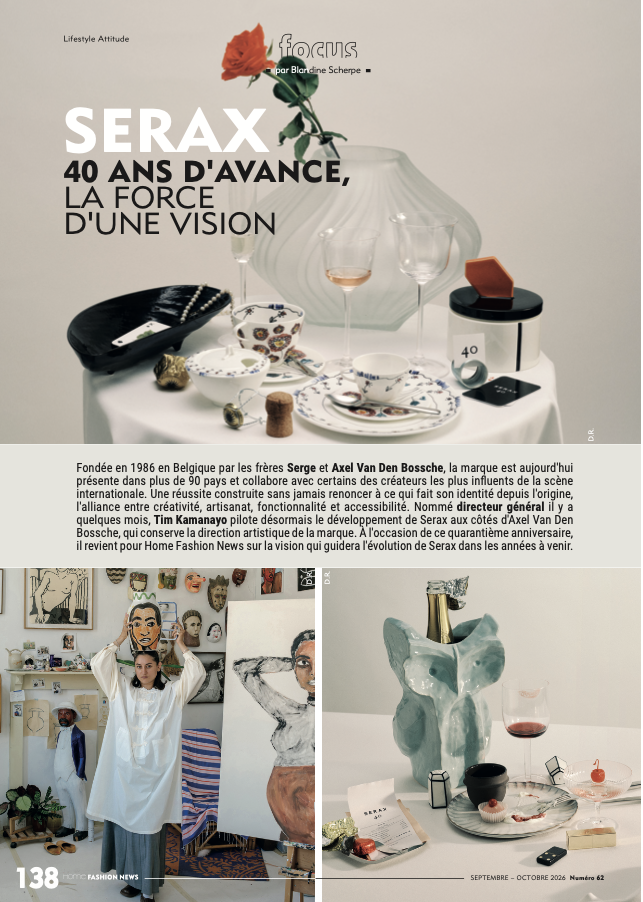
SERAX – 40 YEARS AHEAD: THE POWER OF A VISION
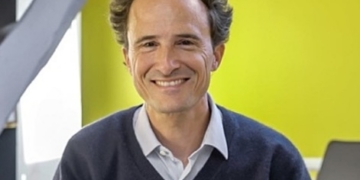
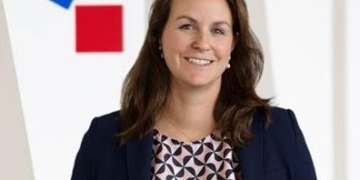
Founded in Belgium in 1986 by brothers Serge and Axel Van Den Bossche, Serax is now present in more than 90 countries and collaborates with some of the most influential figures on the international creative scene. Its success has been built without ever compromising the principles that have defined its identity from the outset: a combination of creativity, craftsmanship, functionality and accessibility. Appointed CEO a few months ago, Tim Kamanayo now oversees Serax’s development alongside Axel Van Den Bossche, who remains the brand’s artistic director. On the occasion of its 40th anniversary, he spoke to Home Fashion News about the vision that will guide Serax’s development in the years ahead.
The story of Serax has its roots well before the company was officially founded. In the 1970s, the founders’ mother was already selling handcrafted copper flowerpots to florists. Inspired by this entrepreneurial heritage, Serge and Axel Van Den Bossche launched their own company in 1986, creating its name from their first names: “Ser” and “Ax”. Initially specialising in planters and accessories for florists, the company gradually began developing its own collections and attracting the attention of the design world. From the 1990s onwards, Serax began its transformation by collaborating with renowned floral designers and taking part in major international trade fairs such as Maison&Objet.
BETTING ON CREATIVE TALENT, FORTY YEARS ON
The real turning point in Serax’s history came in the early 2000s, when the Belgian company chose to become a platform for designers, architects, fashion designers and chefs to express their creativity. Under the impetus of Axel Van Den Bossche, Serax embraced the idea that everyday objects deserved the same level of creative ambition as collectible pieces. Over the years, the company has brought together a diverse group of talents including Ann Demeulemeester, Vincent Van Duysen, Sergio Herman, Paola Navone, Piet Boon, Kelly Wearstler, Yotam Ottolenghi and Marie Michielssen. Each brings a distinctive creative universe while contributing to a shared identity based on design that is beautiful, functional and enduring. Forty years later, however, this strategy faces a paradox. What once made Serax distinctive has now become widespread practice in the world of interiors and lifestyle. “For a long time, we were one of the few brands collaborating with designers, chefs and fashion designers. Today, many brands do it. That makes our work much more demanding,” observes Tim Kamanayo. The difference therefore no longer lies in collaborating with creative talent, but in the way those collaborations are built. While many brands first define a product or a brief before approaching a designer, Serax takes a radically different approach. “We give them carte blanche,” he explains. At Serax, the starting point is the creator, not the product. The teams first seek to understand a personality, a perspective, a sensibility and an individual approach to design. The collections then gradually emerge through an ongoing dialogue between the designer and the brand, far removed from the logic of a straightforward commission. “Today, we go further with our creative partners. We prefer to explore each collaboration in greater depth and build long-term relationships rather than constantly adding new names in response to trends,” continues Tim Kamanayo. These collaborations do more than create new collections; they also enable the brand to reach different audiences. “Some collaborations resonate more strongly with a younger audience, while others appeal to more traditional customers. We need that balance,” the CEO points out. Each designer thus brings their own community, aesthetic language and sensibility, enabling Serax to gradually broaden its audience without giving in to passing trends. The brand also remains deeply committed to craftsmanship. Ceramics, glass, wood, metal and textiles: every collection emerges from a close dialogue between designers and craftspeople, driven by a constant pursuit of innovation and quality. Communication naturally supports this strategy. Social media and digital tools are now the first point of contact with younger generations. Through these channels, they discover designers, gain an understanding of the inspiration behind the collections and begin to engage with the brand’s universe. Digital does not replace the store; it prepares customers for the visit. It sparks curiosity, while the physical point of sale brings the Serax experience fully to life.
GROWING WITH RETAILERS THAT CREATE VALUE
According to Tim Kamanayo, the difficulties facing independent retailers and declining store footfall do not spell the end of physical retail. They do, however, require a fundamental rethink of the role stores play. Consumers no longer visit stores simply to buy an object. They want an experience: to discover an atmosphere, understand the story behind a collection, encounter a designer’s universe and imagine themselves within a complete lifestyle. This shift extends well beyond retail. The development of the hospitality market perfectly illustrates these new expectations. Restaurants, hotels and event venues are no longer looking solely for functional products; they are creating complete experiences in which tableware, furniture, lighting, accessories and decorative objects all contribute to the atmosphere of a space. For Tim Kamanayo, this is precisely the emotion Serax seeks to create, both in professional settings and in consumers’ homes. This vision is leading the brand to invest differently in its retail partnerships. More than simply a supplier, Serax supports retailers in creating dedicated shop-in-shop spaces, develops merchandising recommendations, devises display concepts and provides all the tools they need to tell the stories behind the collections. The designers, materials, inspirations and stories surrounding each creation all become ways of giving the objects greater meaning. “We have analysed the results and we can see that it works,” says Tim Kamanayo. Serax focuses its investment on retailers that share its vision of commerce, commit to the customer experience and actively bring the collections to life. The brand therefore favours long-term partnerships over achieving the widest possible distribution. In this way, Serax continues to grow in its established markets thanks to partners that have successfully embraced the changing role of the store. In the brand’s view, the quality of the collections remains essential, but is no longer enough. Products must now be accompanied by storytelling, presentation and emotion capable of creating a form of value that neither online retail nor a simple copy can reproduce.
FRANCE: A STRATEGIC MARKET FOR THE FUTURE
France occupies a central place in Serax’s growth ambitions. “France is currently our second-largest market. But we are convinced that it has the potential to become our largest. We still see many opportunities there,” Tim Kamanayo tells us. This confidence is based both on current performance and on the growth opportunities identified by the brand, across traditional distribution channels as well as hotels, restaurants and the wider hospitality sector, where projects combining tableware, furniture, lighting and interior decoration are experiencing sustained growth. To support this ambition, Serax has recently recruited a new sales manager for France. Having a stronger presence on the ground will enable the company to gain a better understanding of market expectations, support its most ambitious projects and strengthen relationships with the brand’s partners.
THE IMPORTANCE OF SEEING OPPORTUNITIES BEFORE DIFFICULTIES
At a time when slowing consumer spending and the challenges facing retail dominate much of the debate within the industry, Tim Kamanayo encourages a different perspective. “We hear a great deal about economic difficulties. But there are opportunities too.” In his view, the aspirations that Serax responds to remain unchanged. Consumers still enjoy entertaining, cooking, sharing meals, enhancing their homes, going to restaurants and creating warm and welcoming living environments. Serax is building its future on the enduring nature of these aspirations, choosing to invest in creativity, its teams, its partners and the experience it offers consumers. This vision is reflected in each of the priorities discussed during our conversation: pursuing ambitious collaborations with designers, supporting retailers committed to customer experience, strengthening the team in France and opening up new avenues for creative expression. Markets evolve, distribution channels are transformed and consumer habits change, but the desire to live in beautiful, warm and inspiring surroundings remains deeply rooted. More than simply a growth strategy, this philosophy appears to have been the guiding principle throughout Serax’s first forty years — and, no doubt, will remain so for the next forty.
Source: Home Fashion News #62 – Sept 2026 / / Traduction : Leila Ahmad