- L’actualité B2B
- Tout
- Acquisition
- Actualités corporate
- Anniversaires
- Awards / récompenses
- Bureau / Office
- CHR/HORECA
- Communication / Marketing des entreprises
- Distribution
- e-commerce
- Événements
- Industrie
- L'actu des salons professionnels
- L'actu Hôtellerie
- L'actualité des filières
- L'actualité RSE des entreprises
- Les grandes interviews
- Nominations
- Packaging
- Resultats financiers
- Retail - Actualité boutiques
- Retail - Actualité des grandes enseignes
- RSE / Économie circulaire
- Made in France
- HFN – Le Magazine
- International content

- L’actualité B2B
- Tout
- Acquisition
- Actualités corporate
- Anniversaires
- Awards / récompenses
- Bureau / Office
- CHR/HORECA
- Communication / Marketing des entreprises
- Distribution
- e-commerce
- Événements
- Industrie
- L'actu des salons professionnels
- L'actu Hôtellerie
- L'actualité des filières
- L'actualité RSE des entreprises
- Les grandes interviews
- Nominations
- Packaging
- Resultats financiers
- Retail - Actualité boutiques
- Retail - Actualité des grandes enseignes
- RSE / Économie circulaire
- Made in France
- HFN – Le Magazine
- International content
Duviver canapés presents “ATHOS”: from aerobatics to the workshop, one single gesture of precision
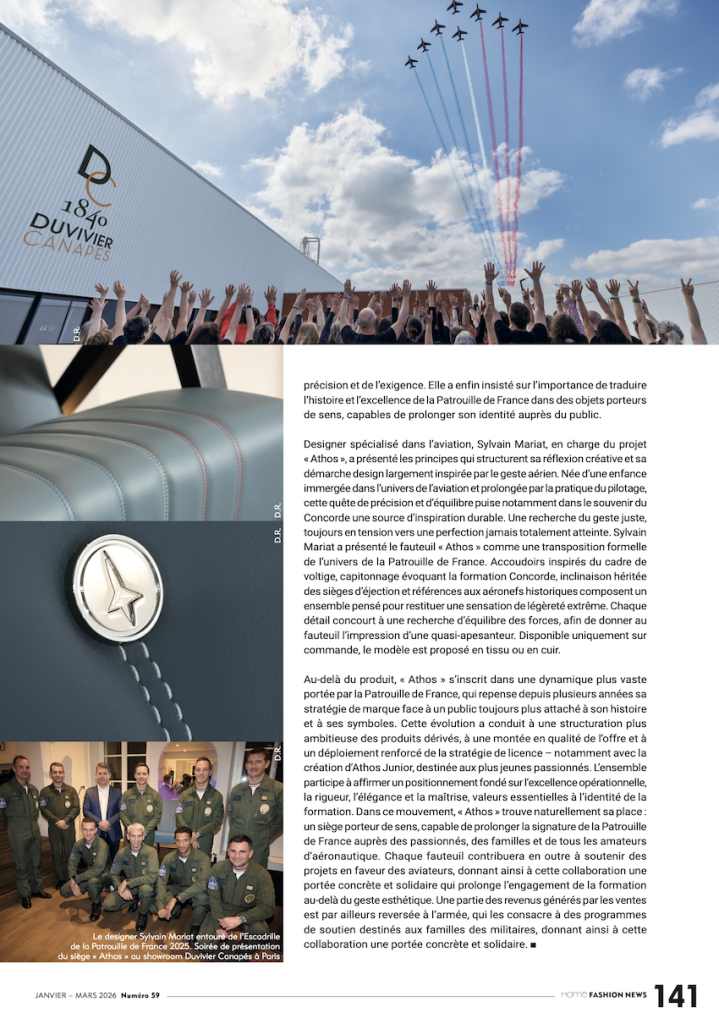
Duvivier Canapés and the Patrouille de France officially unveiled “Athos” in Paris during a landmark evening that brought together all the pilots. Home Fashion News attended the event, which sealed an unprecedented partnership between a flagship of French aviation and a house certified since 2006 for the excellence of its craftsmanship. The evening set the tone for a project designed to showcase France, at the crossroads of two worlds guided by mastery, transmission and the pursuit of the perfect gesture.
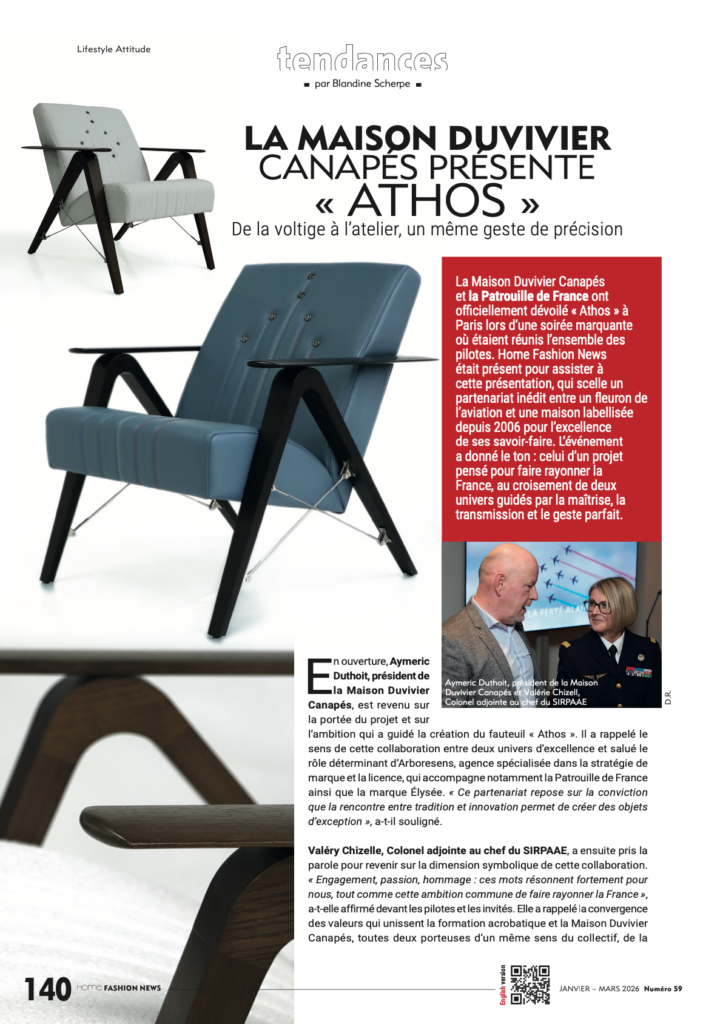
Opening the evening, Aymeric Duthoit, President of Duvivier Canapés, reflected on the scope of the project and the ambition behind the creation of the “Athos” armchair. He recalled the meaning of this collaboration between two worlds of excellence and highlighted the decisive role of Arborens, an agency specialising in brand strategy and licensing, which notably supports the Patrouille de France as well as the Élysée brand. “This partnership is based on the conviction that bringing tradition and innovation together makes it possible to create exceptional objects,” he emphasised.
Valéry Chizelle, Deputy Colonel to the Head of SIRPAAE, then took the floor to highlight the symbolic dimension of the collaboration. “Commitment, passion, tribute: these words resonate strongly for us, as does this shared ambition to make France shine,” she stated before the pilots and guests. She underlined the convergence of values shared by the aerobatic team and Duvivier Canapés, both driven by collective effort, precision and high standards. She also stressed the importance of translating the history and excellence of the Patrouille de France into meaningful objects capable of extending its identity to the public.
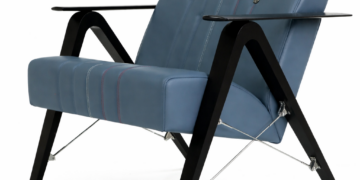
An aviation-specialised designer, Sylvain Mariat, in charge of the “Athos” project, then presented the principles shaping his creative vision and design approach, largely inspired by aerial movement. Born from a childhood immersed in aviation and extended through the practice of flying, this pursuit of precision and balance draws in particular on memories of the Concorde as a lasting source of inspiration. It is a constant search for the right gesture, always striving toward a perfection never fully attained. Sylvain Mariat described the “Athos” armchair as a formal transposition of the Patrouille de France universe. Armrests inspired by aerobatic frames, upholstery evoking the Concorde formation, a tilt inherited from ejection seats and references to historic aircraft come together in a composition designed to convey a feeling of extreme lightness. Every detail contributes to a balance of forces, giving the armchair an impression of near weightlessness. Available exclusively to order, the model is offered in fabric or leather.
Beyond the product itself, “Athos” is part of a broader dynamic led by the Patrouille de France, which has been rethinking its brand strategy for several years to reach an audience increasingly attached to its history and symbols. This evolution has resulted in a more ambitious structuring of licensed products, an upgrade in quality and a strengthened licensing strategy—notably with the creation of “Athos Junior”, designed for younger enthusiasts. Together, these initiatives reinforce a positioning based on operational excellence, rigor, elegance and mastery, values central to the identity of the formation. Within this movement, “Athos” naturally finds its place: a meaningful piece capable of extending the Patrouille de France signature to enthusiasts, families and aviation lovers alike. Each armchair will also help support projects benefiting aviators, giving the collaboration a concrete charitable dimension. A portion of the revenue generated by sales will be donated to the French Air Force to support programs for military families, giving the project a tangible and solidaristic impact.
Duvivier Canapés joins C4 Industries’ Excellence Manufacturing Division
In 2025, Duvivier Canapés joins the Excellence Manufacturing Division of C4 Industries. This integration forms part of a long-term project led by Pascal Cagni, founder of the group, whose commitment to French know-how goes far beyond a purely investment-driven logic. A business leader and investor, he defines himself above all as a builder of industrial ecosystems.
His vision is rooted in a simple yet demanding conviction: industry and craftsmanship are not opposing forces—they strengthen one another. Through C4 Industries, presented as a multi-sector entrepreneurial platform, he develops a transversal reading of the art of living, linking tableware, textiles, furniture and decorative crafts within a cultural and functional coherence that remains rare in a home market historically marked by fragmentation.
This approach finds a natural extension in his public engagement. As Chairman of the Board of Business France since 2017, he works to strengthen France’s economic attractiveness and promote its companies internationally. His trajectory is guided by the same strategic vision, according to which industry, culture and the art of living constitute major levers of French influence—provided they are conceived together and embedded in a long-term perspective.
Born in Alsace, at the heart of a region shaped by the great glassmaking and ceramic manufactures of eastern France, Pascal Cagni claims an intimate relationship with material, gesture and tool. This deeply rooted industrial culture engages in dialogue with another source of inspiration: northern Italy, where leading publishers have long succeeded in articulating furniture, textiles and decoration within a global vision inherited from classicism and continually reinterpreted through contemporary design. For him, strategy is never dissociated from sensory experience or the reality of workshops. The industrial modernisation he advocates is primarily intended to free artisanal work, ensure its transmission and guarantee its economic sustainability.
Through C4 Industries, the project he is building in the world of high-end art de vivre is deployed according to a patrimonial model, with no exit horizon. It is based on productive investment, team stability and the gradual value enhancement of the integrated houses. The ambition is clear: to enable France to assert, on the international stage, a contemporary and credible interpretation of its art of living—anchored as much in manufacturing excellence as in the ability to engage with the present.
In the selection of the houses brought together within the group, one common denominator prevails: companies rich in know-how, often bearing the Entreprise du Patrimoine Vivant label, yet weakened by decades of industrial underinvestment. As Pascal Cagni sums it up: “These are not brands to be saved through discourse, but through tools.” Priority is therefore given to the modernisation of production resources. Looms, warping machines, industrial presses and state-of-the-art digital tools are deployed to restore performance without altering the gesture. The objective is not excessive industrialisation, but the revalorisation of artisanal work, freed from technical constraints that have become obsolete.
This logic permeates all crafts, from faience to textiles and furniture. In several manufactories, the introduction of new technologies has significantly reduced scrap rates and improved productivity, allowing energy to be concentrated on high value-added stages, from decoration to finishing. Industrial progress thus appears not as a renunciation, but as the very condition of artisanal sustainability.
The project carried by C4 Industries is rooted in the long term, with teams engaged on a lasting basis and talents integrated into a logic of transmission and continuous development. Ultimately, the ambition is to structure coherent ecosystems. The pooling of resources, support functions, communication, showrooms and customer experience is intended to enable the group’s houses to gain in clarity and strength, particularly on the international stage.
It is within this continuity that Duvivier Canapés joins the Excellence Manufacturing Division of C4 Industries. Founded in 1840 and based for nearly two centuries in Usson-du-Poitou, the house joins a group determined to structure a value chain of excellence, from creation to international development. Following Lelièvre in 2024 and the Faïencerie de Gien in 2025, this integration confirms the group’s ambition to bring together manufactories that embody the very best of French craftsmanship.
Source: Home Fashion News Jan26