- L’actualité B2B
- Tout
- Acquisition
- Actualités corporate
- Anniversaires
- Awards / récompenses
- Bureau / Office
- CHR/HORECA
- Communication / Marketing des entreprises
- Distribution
- e-commerce
- Événements
- Industrie
- L'actu des salons professionnels
- L'actu Hôtellerie
- L'actualité des filières
- L'actualité RSE des entreprises
- Les grandes interviews
- Nominations
- Packaging
- Resultats financiers
- Retail - Actualité boutiques
- Retail - Actualité des grandes enseignes
- RSE / Économie circulaire
- Made in France
- HFN – Le Magazine
- International content



- L’actualité B2B
- Tout
- Acquisition
- Actualités corporate
- Anniversaires
- Awards / récompenses
- Bureau / Office
- CHR/HORECA
- Communication / Marketing des entreprises
- Distribution
- e-commerce
- Événements
- Industrie
- L'actu des salons professionnels
- L'actu Hôtellerie
- L'actualité des filières
- L'actualité RSE des entreprises
- Les grandes interviews
- Nominations
- Packaging
- Resultats financiers
- Retail - Actualité boutiques
- Retail - Actualité des grandes enseignes
- RSE / Économie circulaire
- Made in France
- HFN – Le Magazine
- International content
Stelton, the quiet strength of a design that stands the test of time
An emblematic family-owned company in Danish design, Stelton is now led by Mads Ring Damgaard, who took over as CEO in March 2024, succeeding his father-in-law after twenty years at the head of the group. A natural handover for someone who joined the company as early as 2017 as Commercial Director, and who anchors his actions in a logic of continuity. A trajectory and a vision that the CEO shares here, reflecting on the foundations of the brand, his reading of contemporary design, and the directions that will guide its development in the years to come.
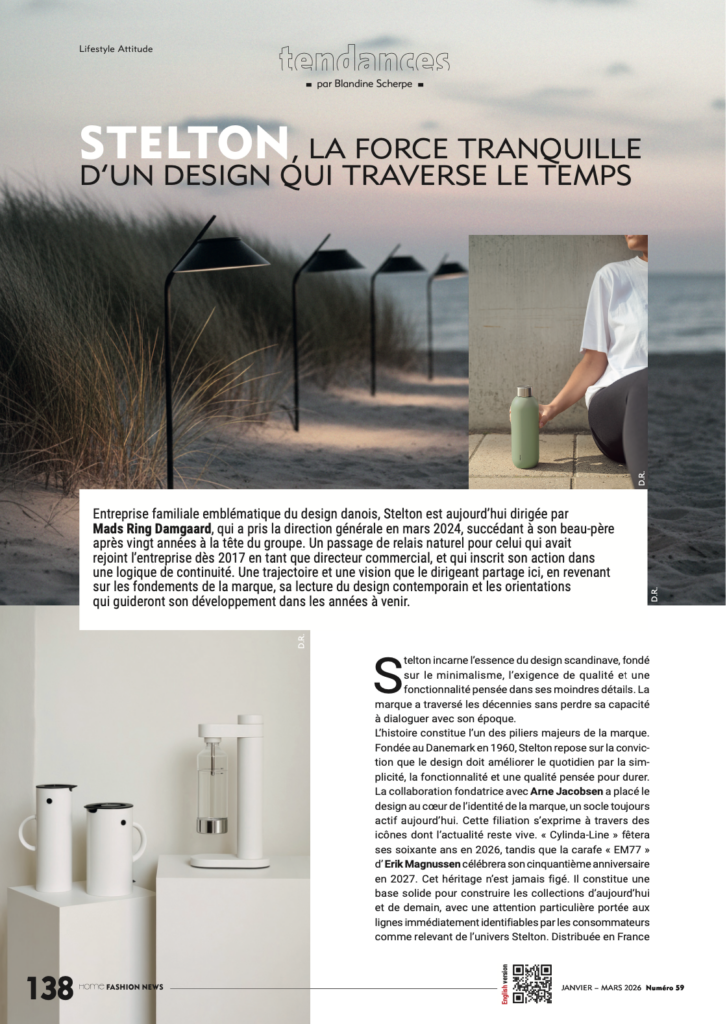
Stelton embodies the essence of Scandinavian design, founded on minimalism, an uncompromising standard of quality, and functionality considered down to the smallest detail. The brand has crossed decades without losing its ability to engage with its time. History is one of the brand’s major pillars. Founded in Denmark in 1960, Stelton is built on the conviction that design should improve everyday life through simplicity, functionality and quality conceived to last. The founding collaboration with Arne Jacobsen placed design at the heart of the brand’s identity, a foundation that remains fully active today. This lineage is expressed through icons whose relevance is still vivid: Cylinda-Line will celebrate its sixtieth anniversary in 2026, while the “EM77” vacuum jug by Erik Magnussen will mark its fiftieth anniversary in 2027. This heritage is never static. It forms a solid base on which to build today’s and tomorrow’s collections, with particular attention paid to lines that are immediately identifiable by consumers as belonging to the Stelton universe. Distributed in France by Glob Studio, Stelton appeals to a clientele sensitive to sustainable design and meaningful objects, both in concept stores and department stores, with particularly strong potential when presented in settings worthy of its heritage.
From an organisational standpoint, the brand relies on structured governance, with a board of directors bringing together complementary expertise in design, strategy and international development. For Mads Ring Damgaard, the quality of the profiles and collective cohesion ensure continuity and a vision rooted in the long term.
On the international stage, Stelton claims a singular position. Deeply rooted in Denmark and Scandinavia, the brand is part of an open design culture, without ever being reduced to a specific aesthetic or territory. On a global scale, it is perceived as a player embodying calm, permanence and cultural depth. Even when the Stelton name is not immediately recognised, some of its emblematic pieces are instinctively identified. The brand fully participates in the contemporary dialogue around the art of living, defending a vision of design that favours meaning and longevity over the succession of fleeting trends. International development currently rests on key markets such as Denmark, Sweden, Norway and Germany, where the brand has established structures. At the same time, Stelton explores international collaborations that foster cross-recognition, such as partnerships developed over time with Paul Smith, Norman Foster and Bernadotte & Kylberg. Long focused on tableware, the brand has gradually expanded its field of expression to home textiles, small domestic appliances and lighting. This evolution is conceived as a natural extension of its universe, with the ambition of strengthening its legitimacy within the home. At Stelton, coherence is not seen as a limitation, but as a strength—particularly in a world marked by constant acceleration.
Each development begins with a precise intention. Design is approached as a space for reflection on how objects structure everyday life. The objective is to identify usage irritants and respond to them with meaningful objects, designed with rigour. Simplicity is regarded as a demanding discipline, never as a stylistic effect. The pursuit of permanence takes precedence over immediate novelty, with particular attention paid to use, materials and proportions.
The growing interest of the high-end hospitality sector accompanies this evolution. Stelton has recently strengthened its presence in this segment, appealing to establishments seeking objects that are both functional and carriers of aesthetic values. In Paris, its products have notably been selected by the LVMH group for the Cheval Blanc hotel, as well as by the Bulgari Hotel. Although this market remains targeted, it is experiencing sustained growth. Some collaborations have even given rise to products now integrated into the general catalogue, such as the “EM77” electric kettle in a 0.5-litre version, initially designed in response to the specific expectations of luxury hospitality. Another key reference in the hospitality and foodservice universe, the “Cylinda” collection continues to grace the tables of some of the most demanding restaurants.
On the occasion of Ambiente 2026, Stelton will unveil several structuring new developments. New colourways will also enrich the existing range. The year 2026 will further mark the launch of a bed linen line, initially intended for Denmark and Northern Europe, before a gradual rollout to other markets, due to regional differences in dimensions. After Frankfurt, Stelton will continue the dialogue with design professionals at 3daysdesign 2026, from June 10 to 12 in Copenhagen. A truly international rendezvous, this event has established itself as a key moment for buyers and specifiers seeking brands that embody a sustainable and committed vision of contemporary design.
Source: Home Fashion News Jan26