- L’actualité B2B
- Tout
- Acquisition
- Actualités corporate
- Anniversaires
- Awards / récompenses
- Bureau / Office
- CHR/HORECA
- Communication / Marketing des entreprises
- Distribution
- e-commerce
- Événements
- Industrie
- L'actu des salons professionnels
- L'actu Hôtellerie
- L'actualité des filières
- L'actualité RSE des entreprises
- Les grandes interviews
- Nominations
- Packaging
- Resultats financiers
- Retail - Actualité boutiques
- Retail - Actualité des grandes enseignes
- RSE / Économie circulaire
- Made in France
- HFN – Le Magazine
- International content




- L’actualité B2B
- Tout
- Acquisition
- Actualités corporate
- Anniversaires
- Awards / récompenses
- Bureau / Office
- CHR/HORECA
- Communication / Marketing des entreprises
- Distribution
- e-commerce
- Événements
- Industrie
- L'actu des salons professionnels
- L'actu Hôtellerie
- L'actualité des filières
- L'actualité RSE des entreprises
- Les grandes interviews
- Nominations
- Packaging
- Resultats financiers
- Retail - Actualité boutiques
- Retail - Actualité des grandes enseignes
- RSE / Économie circulaire
- Made in France
- HFN – Le Magazine
- International content
Veuve Clicquot x Simon Porte Jacquemus: inside the workshop of a contemporary silversmithing masterpiece
By reinventing an object from the 18th century, Veuve Clicquot and Simon Porte Jacquemus have created a rare piece of silversmithing where heritage craftsmanship and contemporary creativity converge. At the heart of the project is Parisian master silversmith Camille Gras, an exceptional artisan and one of the last custodians of a nearly vanished gesture.
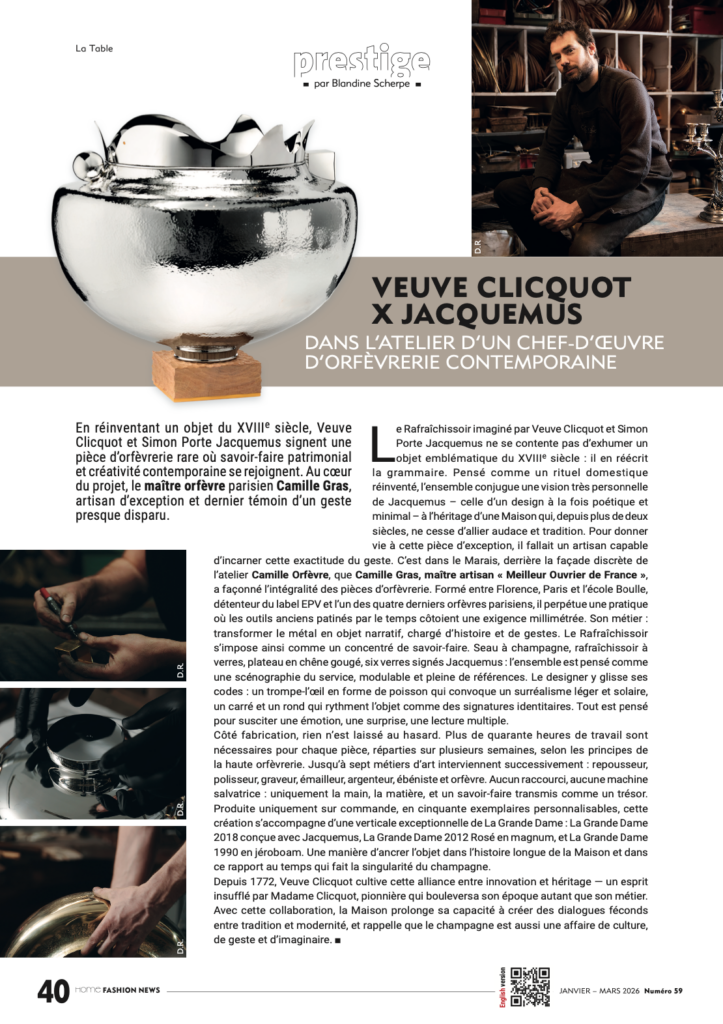
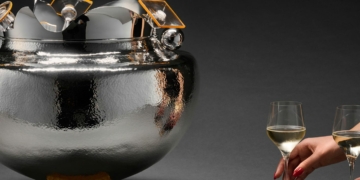
The Ice Bucket imagined by Veuve Clicquot and Simon Porte Jacquemus does more than revive an emblematic 18th-century object: it rewrites its grammar. Conceived as a reinvented domestic ritual, the ensemble brings together Jacquemus’s highly personal vision—one of design that is both poetic and minimal—with the heritage of a House that, for more than two centuries, has continually combined boldness and tradition. To bring this exceptional piece to life, an artisan capable of embodying such precision of gesture was required. It is in the Marais, behind the discreet façade of the Camille Orfèvre workshop, that Camille Gras, master craftsman and Meilleur Ouvrier de France, shaped every silversmithing component. Trained between Florence, Paris and the École Boulle, holder of the EPV label and one of the last four Parisian silversmiths, he perpetuates a practice in which time-worn traditional tools coexist with millimetric precision. His craft: transforming metal into a narrative object, charged with history and gesture. The Ice Bucket thus emerges as a concentrated expression of savoir-faire. Champagne bucket, glass cooler, gouged oak tray, six glasses signed Jacquemus: the ensemble is conceived as a service scenography, modular and rich in references. The designer weaves in his codes: a fish-shaped trompe-l’œil evoking a light, sun-kissed surrealism; a square and a circle that punctuate the object like identity signatures. Everything is designed to spark emotion, surprise and multiple readings.
On the production side, nothing is left to chance. More than forty hours of work are required for each piece, spread over several weeks, in accordance with the principles of high silversmithing. Up to seven crafts intervene successively: repoussé worker, polisher, engraver, enameller, silversmith, cabinetmaker and goldsmith. No shortcuts, no labour-saving machines—only the hand, the material, and a savoir-faire passed down like a treasure. Produced exclusively to order, in fifty customisable editions, this creation is accompanied by an exceptional vertical of La Grande Dame: La Grande Dame 2018 created with Jacquemus, La Grande Dame 2012 Rosé in magnum, and La Grande Dame 1990 in jeroboam. A way of anchoring the object in the long history of the House and in that relationship to time which defines the singularity of champagne.
Since 1772, Veuve Clicquot has cultivated this alliance between innovation and heritage—an ethos instilled by Madame Clicquot, a pioneer who transformed her era as much as her craft. With this collaboration, the House extends its ability to create fertile dialogues between tradition and modernity, and reminds us that champagne is also a matter of culture, gesture and imagination.
Source: Home Fashion News Jan26