- L’actualité B2B
- Tout
- Acquisition
- Actualités corporate
- Anniversaires
- Awards / récompenses
- Bureau / Office
- CHR/HORECA
- Communication / Marketing des entreprises
- Distribution
- e-commerce
- Etudes de marché
- Événements
- Industrie
- L'actu des salons professionnels
- L'actu Hôtellerie
- L'actualité des filières
- L'actualité RSE des entreprises
- Les grandes interviews
- Nominations
- Packaging
- Resultats financiers
- Retail - Actualité boutiques
- Retail - Actualité des grandes enseignes
- RSE / Économie circulaire
- Made in France
- HFN – Le Magazine
- International content












- L’actualité B2B
- Tout
- Acquisition
- Actualités corporate
- Anniversaires
- Awards / récompenses
- Bureau / Office
- CHR/HORECA
- Communication / Marketing des entreprises
- Distribution
- e-commerce
- Etudes de marché
- Événements
- Industrie
- L'actu des salons professionnels
- L'actu Hôtellerie
- L'actualité des filières
- L'actualité RSE des entreprises
- Les grandes interviews
- Nominations
- Packaging
- Resultats financiers
- Retail - Actualité boutiques
- Retail - Actualité des grandes enseignes
- RSE / Économie circulaire
- Made in France
- HFN – Le Magazine
- International content
AT THE HEART OF OPINEL’S SUCCESS : THE STRENGTH OF LONG-TERM THINKING
Last spring, Home Fashion News visited Chambéry, Opinel’s historic home. Behind the walls of a manufacturing site that has been extensively modernised in recent years, the famous Savoyard brand continues to develop with remarkable consistency. Cherished by generations of French consumers, it remains guided by a family that is still closely involved in the company’s major strategic decisions. While operational management is now entrusted to Managing Director Luc Simon, Opinel’s heirs remain committed to safeguarding the values that have shaped its identity since 1890. This distinctive model, combining independent management with family ownership committed to the long term, gives the brand the stability and freedom it needs to continue developing in what is now a global market.
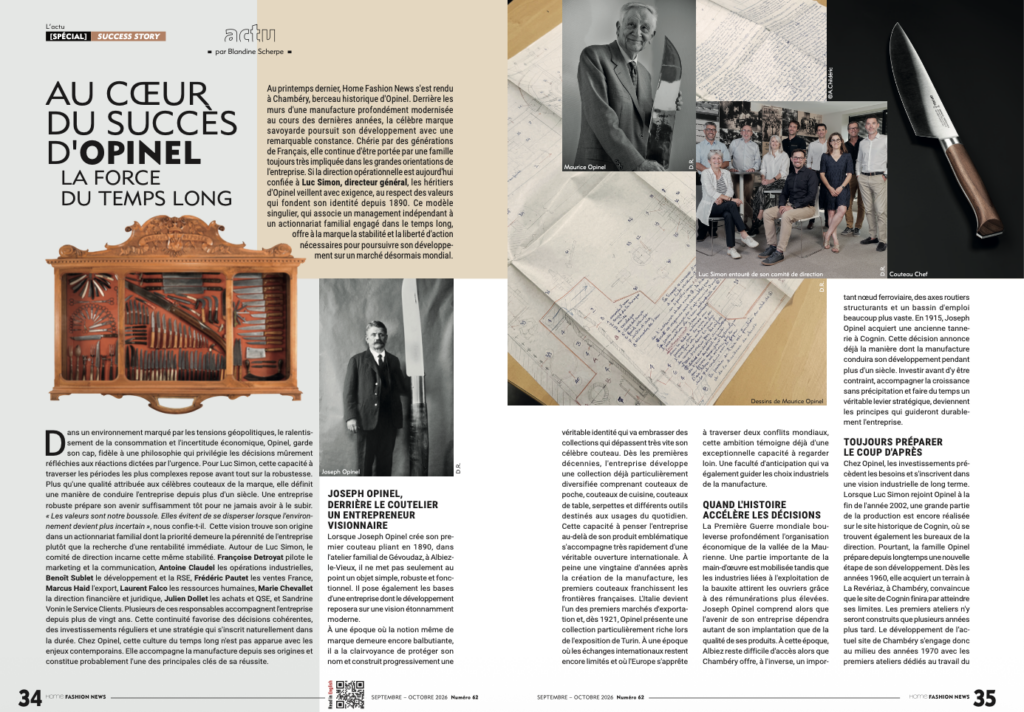
In an environment marked by geopolitical tensions, slowing consumer spending and economic uncertainty, Opinel is staying its course, faithful to a philosophy that favours carefully considered decisions over reactions dictated by urgency. For Luc Simon, the ability to navigate the most challenging periods depends above all on robustness. More than a quality associated with the brand’s famous knives, it defines the way the company has been run for more than a century. A robust company prepares for its future early enough never to have it imposed upon it. “Our values are our compass. They prevent us from losing focus when the environment becomes more uncertain,” he tells us. This vision stems from family ownership whose priority remains the long-term future of the company rather than the pursuit of immediate profitability. Alongside Luc Simon, the management committee embodies the same stability. Françoise Detroyat oversees marketing and communication, Antoine Claudel industrial operations, Benoît Sublet development and CSR, Frédéric Pautet sales in France, Marcus Haid exports, Laurent Falco human resources, Marie Chevallet finance and legal affairs, Julien Dollet purchasing and QSE, and Sandrine Vonin Customer Service. Several of these managers have been with the company for more than twenty years. This continuity encourages consistent decision-making, regular investment and a strategy naturally rooted in the long term. At Opinel, this culture of long-term thinking did not emerge in response to today’s challenges. It has been part of the manufacturing company since its beginnings and is probably one of the main keys to its success.
JOSEPH OPINEL: A VISIONARY ENTREPRENEUR BEHIND THE KNIFE MAKER
When Joseph Opinel created his first folding knife in 1890 in the family workshop in Gévoudaz, Albiez-le-Vieux, he did more than develop a simple, robust and functional object. He also laid the foundations of a company whose development would be based on a remarkably modern vision. At a time when the very concept of a brand was still in its infancy, he had the foresight to protect his name and gradually built a genuine identity encompassing collections that quickly extended beyond his famous knife. From its earliest decades, the company developed an already highly diversified collection including pocket knives, kitchen knives, table knives, pruning knives and various tools for everyday use. This ability to think beyond the company’s iconic product was soon accompanied by a genuine international outlook. Barely twenty years after the manufacturing business was founded, the first knives crossed France’s borders. Italy became one of its first export markets and, as early as 1921, Opinel presented an extensive collection at the Turin exhibition. At a time when international trade was still limited and Europe was about to experience two world wars, this ambition already demonstrated an exceptional ability to look ahead. This same capacity for anticipation would also guide the company’s industrial decisions.
WHEN HISTORY ACCELERATES DECISION-MAKING
The First World War profoundly disrupted the economic organisation of the Maurienne Valley. A significant proportion of the workforce was mobilised, while industries linked to bauxite extraction attracted workers with higher wages. Joseph Opinel realised that the future of his company would depend as much on its location as on the quality of its products. At the time, Albiez remained difficult to access, whereas Chambéry offered a major railway hub, key road links and a much larger employment pool. In 1915, Joseph Opinel acquired a former tannery in Cognin. This decision already foreshadowed the way the company would manage its development for more than a century: investing before being forced to do so, supporting growth without rushing, and making time a genuine strategic lever became principles that would guide the business for decades.
ALWAYS PREPARING FOR THE NEXT STEP
At Opinel, investment comes before needs arise and forms part of a long-term industrial vision. When Luc Simon joined Opinel at the end of 2002, much of the production was still carried out at the historic Cognin site, which also housed the management offices. Yet the Opinel family had long been preparing for the company’s next stage of development. As early as the 1960s, it acquired land at La Revériaz in Chambéry, convinced that the Cognin site would eventually reach its limits. The first workshops were not built there until several years later. Development of the current Chambéry site therefore began in the mid-1970s with the first workshops dedicated to woodworking. Over time, all activities were brought together there, from shaping handles and assembling knives to blade grinding, ring production, packaging and administrative services. Bringing this expertise together has streamlined communication, optimised production flows and strengthened quality control.
Over the past ten years, the site has continued to expand, with larger grinding and locking-ring production workshops and the construction of a major logistics building for raw materials and finished products. Each of these investments serves the same ambition: to support the long-term development of the company while reinforcing its commitment to manufacturing in France. The Savoyard manufacturer continues to grow steadily, supported by investments planned well in advance. This ability to anticipate continues to guide its decisions. Opposite the current Chambéry site, Opinel recently acquired additional land that could eventually accommodate a building dedicated to logistics and order preparation when required. Such a move would free up additional production space on the historic site. This strategy has enabled the company to keep pace with the strong growth in its business. In just over twenty years, turnover has risen from less than €10 million to almost €34 million, while the workforce now numbers 160 employees. Following a particularly dynamic 2023, supported by industrial investments initiated well in advance, Opinel is now focusing on balanced development in line with its changing needs.
FRENCH MANUFACTURING AS A COMPETITIVE ADVANTAGE
This long-term vision is also reflected in Opinel’s consistently reaffirmed commitment to manufacturing in France. For Opinel, Made in France is not a marketing argument but a genuine industrial strategy. For several decades, the company has continuously invested in its production facilities to modernise equipment, improve manufacturing processes and strengthen its competitiveness. This approach enables it to retain control over every stage of manufacturing while offering products recognised for their excellent value for money. “Above all, we seek to make our manufacturing operations increasingly efficient. It is this commitment that allows us to remain competitive while continuing to manufacture our knives in Savoie,” says Luc Simon. Continuous improvement is therefore a permanent operating principle. Investment is not driven solely by increases in volume. It also supports developments in industrial processes, equipment and workshop organisation in order to improve efficiency, quality and flexibility.
This control over production is now a genuine competitive advantage. It gives Opinel considerable responsiveness and ensures the consistent quality on which its reputation is built. This industrial expertise supports the brand’s development. While France still accounts for just over half of its business, exports now represent close to 45% of turnover. Both markets are growing in parallel, ensuring balanced growth. Opinel is also continuing to develop its business with corporate-gifting professionals and in the restaurant and hotel sectors. Each of these markets contributes to strengthening the brand’s presence over the long term.
INNOVATING BETTER, EVERY TIME
More than half of the products currently sold by Opinel have been developed over the past fifteen years. This evolution has been built around the same high standards that have always characterised the company. Every creation addresses an identified use, fits naturally into the collections and is designed to last. This approach is accompanied by rigorous investment management. Increasing the number of launches means renewing moulds, packaging, production tools and sales materials – significant resources that the company prefers to devote to long-lasting projects.
Rather than accumulating new products, the teams reassess each product family every four to five years in order to develop materials, features, colours or packaging. This process of continuous improvement delivers genuine added value to users while keeping the product offering clear and easy to understand. Iconic products therefore remain in the catalogue for many years, evolving in step with technical advances and new uses rather than simply following trends. “We develop our offering without ever moving away from our core expertise. Every new product must have a purpose and naturally extend our know-how,” Luc Simon explains. Although the folding knife remains the company’s emblem, it now provides the foundation for a much broader universe. Cooking, barbecuing, gardening, picnics, outdoor activities and products for children all naturally extend the brand’s historic expertise.
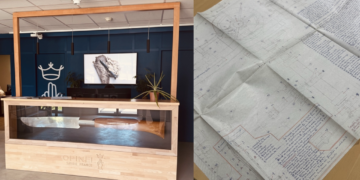
This diversification follows in the spirit of Opinel’s earliest years, when Joseph Opinel already offered a wide variety of knives and tools designed for everyday use. The three stores in Chambéry, Annecy and Lyon bring this universe fully to life. All share the same brand territory while expressing their own personality. The museum incorporated into the Chambéry store, the workshop in Lyon and Annecy’s high level of tourist traffic illustrate the desire to adapt each location to its environment while introducing visitors to the history, expertise and values that have shaped Opinel since 1890.
PASSING ON MORE THAN KNOW-HOW
This long-term vision is also reflected in the way Opinel prepares for its future workforce. The company pays particular attention to passing on skills and renewing its teams, recognising that the long-term survival of its expertise depends as much on the women and men who embody it as on industrial investment. The company is therefore pursuing several initiatives designed to make it more attractive to younger generations. It is developing partnerships with training organisations and notably supports the École de la Deuxième Chance, helping to promote professional integration and introduce people to careers in industry. At the same time, Opinel has chosen to obtain formal recognition for the social and environmental commitments that have long been embedded in the way it operates. The company notably relies on the EcoVadis assessment, PEFC certification, which guarantees sustainable management of wood resources, and its commitment to the 1% for the Planet movement. This decision to have its approach independently certified responds to growing consumer expectations for transparency and authenticity.
FRANÇOIS OPINEL: GUARDIAN OF THE FAMILY SPIRIT
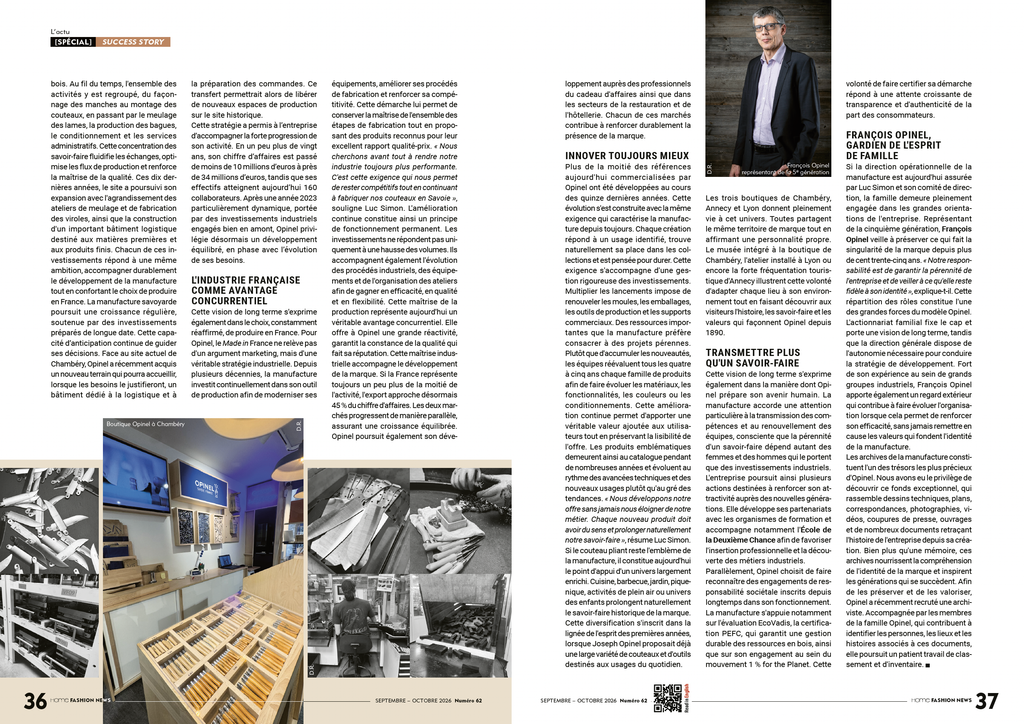
While operational management of the company is now handled by Luc Simon and his management committee, the family remains fully involved in its major strategic decisions. Representing the fifth generation, François Opinel ensures that the qualities that have made the brand unique for more than 135 years are preserved. “Our responsibility is to ensure the long-term future of the company and make sure that it remains true to its identity,” he explains. This division of responsibilities is one of the great strengths of the Opinel model. Family ownership sets the direction and provides a long-term vision, while executive management has the autonomy required to implement the development strategy. Drawing on his experience within major industrial groups, François Opinel also brings an outside perspective that helps the organisation evolve whenever this can improve its efficiency, without ever calling into question the values on which the company’s identity is built.
The company archives are among Opinel’s most precious treasures. We had the privilege of discovering this exceptional collection, which brings together technical drawings, plans, correspondence, photographs, videos, press cuttings, books and numerous documents tracing the company’s history since its creation. Far more than simply a record of the past, these archives contribute to an understanding of the brand’s identity and inspire successive generations. To preserve and showcase them, Opinel recently recruited an archivist. Supported by members of the Opinel family, who help identify the people, places and stories associated with these documents, she is carrying out the painstaking work of cataloguing and inventorying the collection.
Home Fashion News #62 – Sept 2026 / Translation: Leila Ahmad