- L’actualité B2B
- Tout
- Acquisition
- Actualités corporate
- Anniversaires
- Awards / récompenses
- Bureau / Office
- CHR/HORECA
- Communication / Marketing des entreprises
- Distribution
- e-commerce
- Etudes de marché
- Événements
- Industrie
- L'actu des salons professionnels
- L'actu Hôtellerie
- L'actualité des filières
- L'actualité RSE des entreprises
- Les grandes interviews
- Nominations
- Packaging
- Resultats financiers
- Retail - Actualité boutiques
- Retail - Actualité des grandes enseignes
- RSE / Économie circulaire
- Made in France
- HFN – Le Magazine
- International content


- L’actualité B2B
- Tout
- Acquisition
- Actualités corporate
- Anniversaires
- Awards / récompenses
- Bureau / Office
- CHR/HORECA
- Communication / Marketing des entreprises
- Distribution
- e-commerce
- Etudes de marché
- Événements
- Industrie
- L'actu des salons professionnels
- L'actu Hôtellerie
- L'actualité des filières
- L'actualité RSE des entreprises
- Les grandes interviews
- Nominations
- Packaging
- Resultats financiers
- Retail - Actualité boutiques
- Retail - Actualité des grandes enseignes
- RSE / Économie circulaire
- Made in France
- HFN – Le Magazine
- International content
RAYNAUD : WHEN INDUSTRIAL INVESTMENT BECOMES A DRIVER OF DESIRABILITY
Reconciling industrial development with the preservation of exceptional craftsmanship is one of the major challenges facing heritage houses. Maison Raynaud is addressing this challenge with the opening of a new manufacturing facility in Limoges, following an investment of €7 million. Far more than a production facility, this project reflects a strategy combining industrial performance, artisanal excellence, responsible innovation and the transmission of expertise, with the aim of supporting the brand’s growth while cultivating what makes it valuable: the rarity, quality and desirability of its collections.
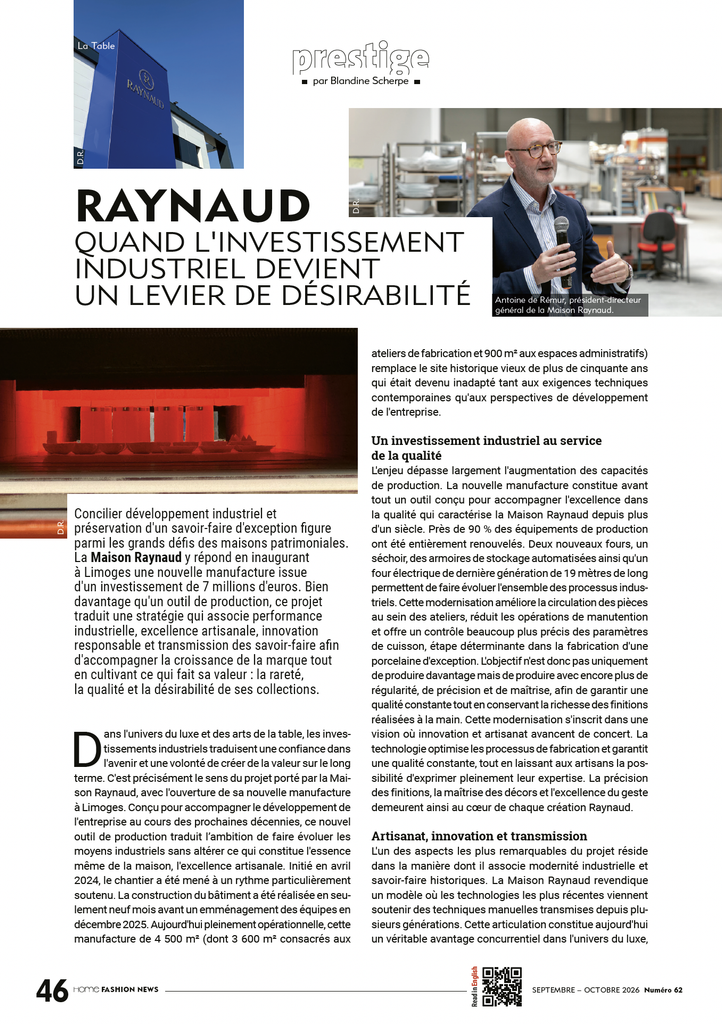
In the world of luxury and tableware, industrial investments reflect confidence in the future and a determination to create long-term value. This is precisely the purpose of Maison Raynaud’s project, with the opening of its new manufacturing facility in Limoges. Designed to support the company’s development over the coming decades, this new production facility reflects the ambition to modernise its industrial resources without altering what lies at the very heart of the house: artisanal excellence.
Launched in April 2024, the project was carried out at a particularly fast pace. The building was constructed in just nine months, before the teams moved in in December 2025. Now fully operational, this 4,500 sq.m manufacturing facility — including 3,600 sq.m dedicated to production workshops and 900 sq.m to administrative areas — replaces the historic site, which was more than fifty years old and had become unsuitable both for contemporary technical requirements and for the company’s future development.
INDUSTRIAL INVESTMENT IN THE SERVICE OF QUALITY
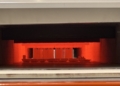
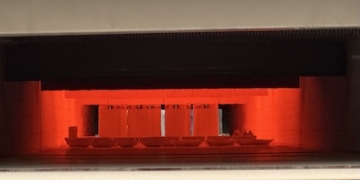
What is at stake goes far beyond increasing production capacity. Above all, the new manufacturing facility has been designed to support the outstanding quality that has characterised Maison Raynaud for more than a century. Nearly 90% of the production equipment has been completely renewed. Two new kilns, a dryer, automated storage cabinets and a latest-generation 19-metre-long electric kiln are enabling the entire industrial process to evolve.
This modernisation improves the flow of pieces through the workshops, reduces handling operations and provides much more precise control over firing parameters, a crucial stage in the production of exceptional porcelain. The objective, therefore, is not simply to produce more, but to produce with even greater consistency, precision and control, ensuring constant quality while preserving the richness of the hand-finished details.
This modernisation is part of a vision in which innovation and craftsmanship go hand in hand. Technology optimises manufacturing processes and ensures consistent quality, while allowing craftspeople to fully express their expertise. The precision of the finishes, mastery of decoration and excellence of craftsmanship thus remain at the heart of every Raynaud creation.
CRAFTSMANSHIP, INNOVATION AND TRANSMISSION
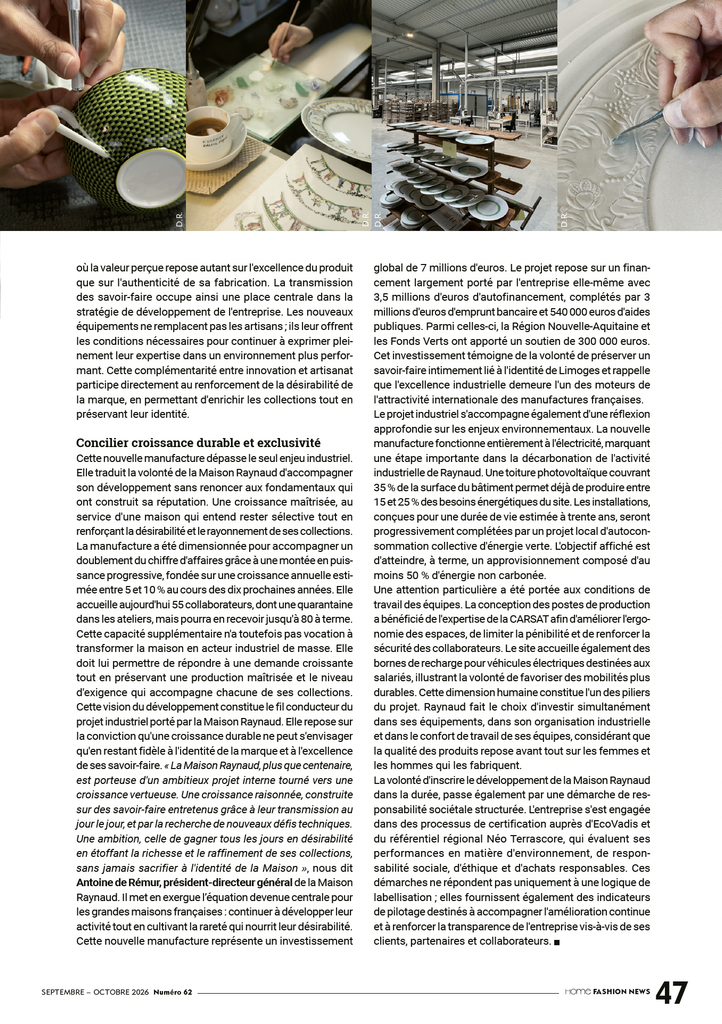
One of the most remarkable aspects of the project lies in the way it combines industrial modernity with historic expertise. Maison Raynaud champions a model in which the latest technologies support manual techniques handed down over several generations. This combination is now a genuine competitive advantage in the luxury sector, where perceived value rests as much on product excellence as on the authenticity of its manufacture.
The transmission of expertise therefore occupies a central place in the company’s development strategy. The new equipment does not replace craftspeople; it provides them with the conditions they need to continue to fully express their expertise in a more efficient environment. This complementarity between innovation and craftsmanship directly contributes to strengthening the brand’s desirability, making it possible to enrich the collections while preserving their identity.
RECONCILING SUSTAINABLE GROWTH AND EXCLUSIVITY
This new manufacturing facility goes beyond purely industrial considerations. It reflects Maison Raynaud’s determination to support its development without abandoning the fundamentals on which its reputation has been built: controlled growth in the service of a house that intends to remain selective while strengthening the desirability and reach of its collections.
The manufacturing facility has been designed to support a doubling of turnover through a gradual increase in capacity, based on estimated annual growth of between 5% and 10% over the next ten years. It currently accommodates 55 employees, around forty of whom work in the production workshops, but will eventually be able to accommodate up to 80. This additional capacity is not, however, intended to turn the house into a mass-production manufacturer. Rather, it will enable it to meet growing demand while preserving controlled production and the exacting standards associated with each of its collections.
This vision of development is the guiding principle behind Maison Raynaud’s industrial project. It is based on the conviction that sustainable growth can only be achieved by remaining faithful to the brand’s identity and the excellence of its expertise.
“Maison Raynaud, which is more than a century old, is pursuing an ambitious internal project focused on virtuous growth. Reasoned growth, built on expertise maintained through its day-to-day transmission and the pursuit of new technical challenges. One ambition: to become more desirable every day by expanding the richness and refinement of our collections, without ever compromising the identity of the House,” says Antoine de Rémur, Chairman and CEO of Maison Raynaud. He highlights an equation that has become central to the leading French houses: continuing to develop their business while cultivating the rarity that fuels their desirability.
This new manufacturing facility represents a total investment of €7 million. The project is largely financed by the company itself, with €3.5 million in self-financing, supplemented by €3 million in bank loans and €540,000 in public funding. Of this public funding, the Nouvelle-Aquitaine Region and the Fonds Verts contributed €300,000.This investment demonstrates the determination to preserve expertise that is intimately linked to the identity of Limoges and serves as a reminder that industrial excellence remains one of the driving forces behind the international appeal of French manufacturers.
The industrial project is also accompanied by in-depth consideration of environmental issues. The new manufacturing facility runs entirely on electricity, marking an important step in the decarbonisation of Raynaud’s industrial operations. A photovoltaic roof covering 35% of the building’s surface area already produces between 15% and 25% of the site’s energy requirements. The installations, designed for an estimated lifespan of thirty years, will gradually be complemented by a local collective green-energy self-consumption project. The stated objective is ultimately to achieve an energy supply comprising at least 50% carbon-free energy.
Particular attention has been paid to the teams’ working conditions. The design of the production workstations benefited from CARSAT’s expertise in order to improve workplace ergonomics, reduce physical strain and enhance employee safety. The site also provides electric-vehicle charging stations for employees, illustrating the company’s determination to encourage more sustainable mobility.
This human dimension is one of the pillars of the project. Raynaud has chosen to invest simultaneously in its equipment, its industrial organisation and its teams’ working conditions, based on the belief that product quality depends above all on the women and men who make them.
Maison Raynaud’s determination to ensure its long-term development is also reflected in a structured approach to corporate social responsibility. The company has embarked on certification processes with EcoVadis and the regional Néo Terrascore framework, which assess its performance in terms of the environment, social responsibility, ethics and responsible purchasing. These initiatives are not solely about obtaining certification; they also provide management indicators designed to support continuous improvement and strengthen the company’s transparency towards its customers, partners and employees.
Home Fashion News #62 – Sept 2026 / Translation: Leila Ahmad