- L’actualité B2B
- Tout
- Acquisition
- Actualités corporate
- Anniversaires
- Awards / récompenses
- Bureau / Office
- CHR/HORECA
- Communication / Marketing des entreprises
- Distribution
- e-commerce
- Événements
- Industrie
- L'actu des salons professionnels
- L'actu Hôtellerie
- L'actualité des filières
- L'actualité RSE des entreprises
- Les grandes interviews
- Nominations
- Packaging
- Resultats financiers
- Retail - Actualité boutiques
- Retail - Actualité des grandes enseignes
- RSE / Économie circulaire
- Made in France
- HFN – Le Magazine
- International content






- L’actualité B2B
- Tout
- Acquisition
- Actualités corporate
- Anniversaires
- Awards / récompenses
- Bureau / Office
- CHR/HORECA
- Communication / Marketing des entreprises
- Distribution
- e-commerce
- Événements
- Industrie
- L'actu des salons professionnels
- L'actu Hôtellerie
- L'actualité des filières
- L'actualité RSE des entreprises
- Les grandes interviews
- Nominations
- Packaging
- Resultats financiers
- Retail - Actualité boutiques
- Retail - Actualité des grandes enseignes
- RSE / Économie circulaire
- Made in France
- HFN – Le Magazine
- International content
Jeff Koons and Bernardaud: the art of dialogue
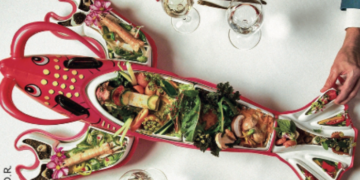
The result of an exceptional collaboration between American artist Jeff Koons and the Bernardaud manufactory, “Lobster” revisits one of the most emblematic works of the artist. Inspired by his famous inflatable lobster, this porcelain sculpture, produced in 99 editions, brings together contemporary art and artisanal excellence.
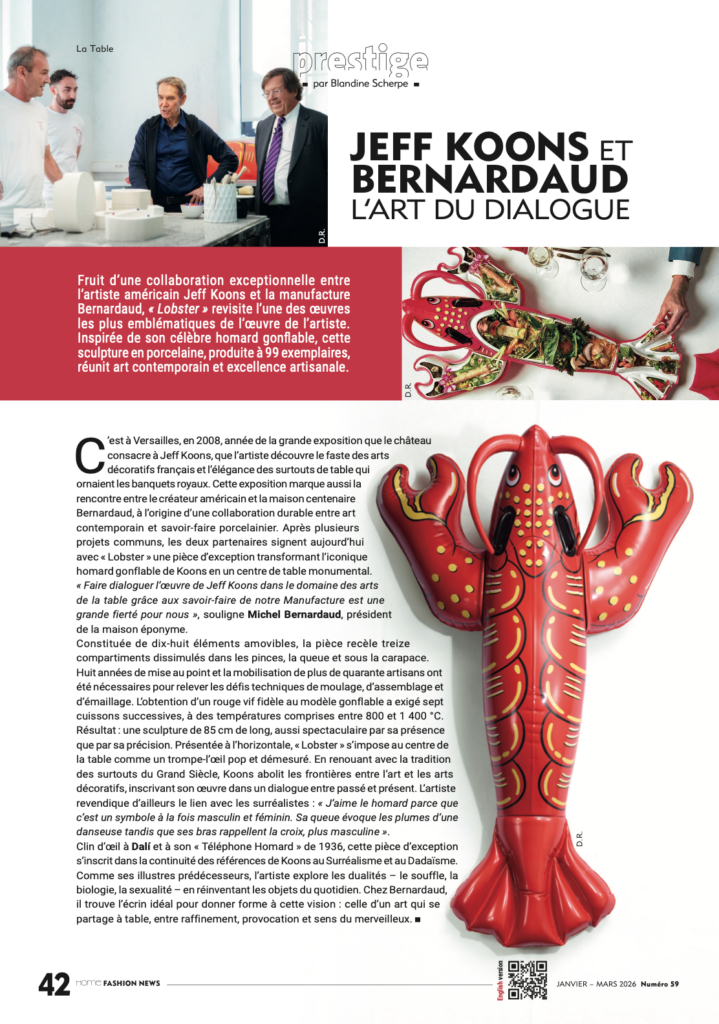
It was in Versailles, in 2008—the year of the major exhibition dedicated to Jeff Koons at the château—that the artist discovered the splendour of French decorative arts and the elegance of the table centrepieces that once adorned royal banquets. This exhibition also marked the meeting between the American creator and the century-old Bernardaud house, giving rise to a lasting collaboration between contemporary art and porcelain savoir-faire. After several joint projects, the two partners now present Lobster, an exceptional piece that transforms Koons’s iconic inflatable lobster into a monumental table centrepiece. “Bringing Jeff Koons’s work into the realm of the table arts through the expertise of our Manufactory is a great source of pride for us,” emphasises Michel Bernardaud, President of the eponymous house.
Composed of eighteen removable elements, the piece conceals thirteen compartments hidden in the claws, the tail and beneath the shell. Eight years of development and the mobilisation of more than forty artisans were required to meet the technical challenges of moulding, assembly and enamelling. Achieving a vivid red faithful to the inflatable model required seven successive firings, at temperatures ranging from 800 to 1,400 °C. The result is a sculpture measuring 85 cm in length, as spectacular in its presence as in its precision. Presented horizontally, Lobster asserts itself at the centre of the table as an oversized pop trompe-l’œil. By reconnecting with the tradition of the surtouts of the Grand Siècle, Koons abolishes the boundaries between art and decorative arts, placing his work within a dialogue between past and present.
The artist also claims a connection with the Surrealists: “I like the lobster because it is a symbol that is both masculine and feminine. Its tail evokes the feathers of a dancer, while its arms recall the cross, which is more masculine.” A nod to Dalí and his 1936 “Lobster Telephone”, this exceptional piece aligns with Koons’s ongoing references to Surrealism and Dadaism. Like his illustrious predecessors, the artist explores dualities—breath, biology, sexuality—by reinventing everyday objects. At Bernardaud, he finds the ideal setting to give form to this vision: that of an art meant to be shared at the table, combining refinement, provocation and a sense of wonder.
Source: Home Fashion News Jan26