- L’actualité B2B
- Tout
- Acquisition
- Actualités corporate
- Anniversaires
- Awards / récompenses
- Bureau / Office
- CHR/HORECA
- Communication / Marketing des entreprises
- Distribution
- e-commerce
- Etudes de marché
- Événements
- Industrie
- L'actu des salons professionnels
- L'actu Hôtellerie
- L'actualité des filières
- L'actualité RSE des entreprises
- Les grandes interviews
- Nominations
- Packaging
- Resultats financiers
- Retail - Actualité boutiques
- Retail - Actualité des grandes enseignes
- RSE / Économie circulaire
- Made in France
- HFN – Le Magazine
- International content


- L’actualité B2B
- Tout
- Acquisition
- Actualités corporate
- Anniversaires
- Awards / récompenses
- Bureau / Office
- CHR/HORECA
- Communication / Marketing des entreprises
- Distribution
- e-commerce
- Etudes de marché
- Événements
- Industrie
- L'actu des salons professionnels
- L'actu Hôtellerie
- L'actualité des filières
- L'actualité RSE des entreprises
- Les grandes interviews
- Nominations
- Packaging
- Resultats financiers
- Retail - Actualité boutiques
- Retail - Actualité des grandes enseignes
- RSE / Économie circulaire
- Made in France
- HFN – Le Magazine
- International content
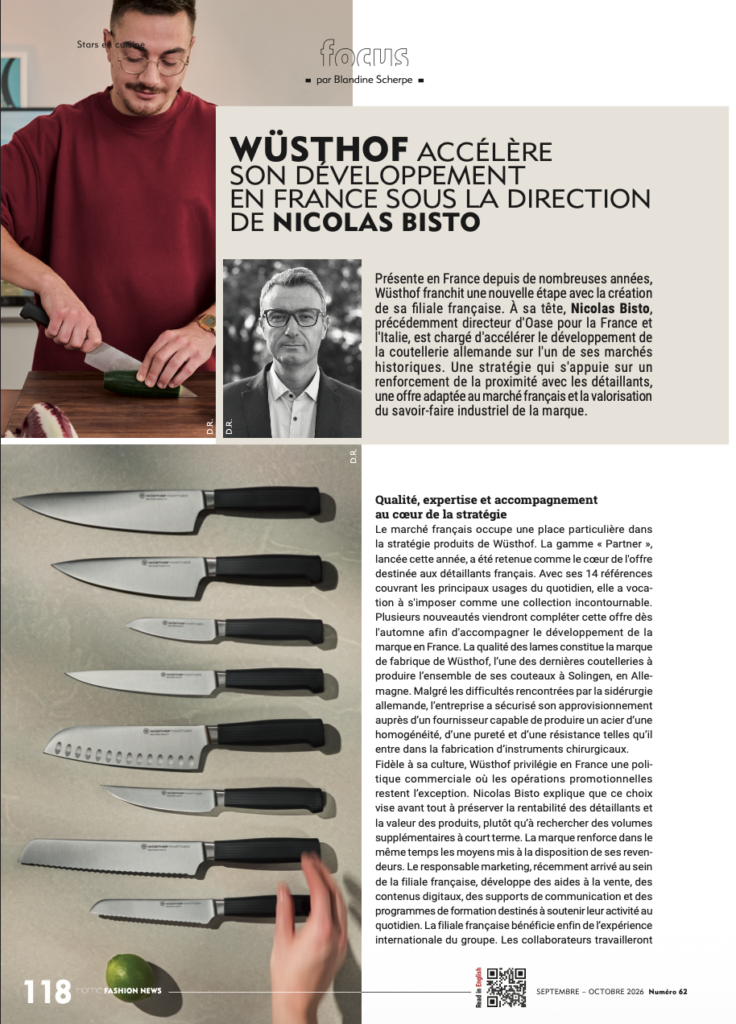
WÜSTHOF ACCELERATES ITS DEVELOPMENT IN FRANCE UNDER THE LEADERSHIP OF NICOLAS BISTO
Present in France for many years, Wüsthof is entering a new phase with the creation of its French subsidiary. At its helm is Nicolas Bisto, formerly Managing Director of Oase for France and Italy, whose mission is to accelerate the German knife manufacturer’s development in one of its long-standing markets. The strategy is based on building closer relationships with retailers, tailoring the product offering to the French market and showcasing the brand’s industrial expertise.
QUALITY, EXPERTISE AND RETAILER SUPPORT AT THE HEART OF THE STRATEGY
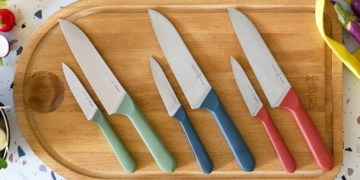
The French market occupies a distinctive position in Wüsthof’s product strategy. The Partner range, launched this year, has been selected as the core offering for French retailers. With 14 references covering the main everyday uses, it is designed to establish itself as an essential collection. Several new products will be added to the range from this autumn onwards to support the brand’s development in France. Blade quality is a hallmark of Wüsthof, one of the last knife manufacturers to produce all its knives in Solingen, Germany. Despite the difficulties facing the German steel industry, the company has secured its supply from a manufacturer capable of producing steel of such consistency, purity and strength that it is also used in the manufacture of surgical instruments.
True to its principles, Wüsthof pursues a commercial policy in France in which promotional campaigns remain the exception. Nicolas Bisto explains that this approach is primarily intended to preserve retailers’ profitability and the value of the products, rather than pursuing additional short-term sales volumes. At the same time, the brand is strengthening the resources available to its retailers. The marketing manager, who recently joined the French subsidiary, is developing sales tools, digital content, communication materials and training programmes designed to support their day-to-day business. The French subsidiary also benefits from the group’s international experience. Team members will work alongside their German, British and American counterparts, while colleagues from other countries will visit France to gain a better understanding of the French market. These exchanges will facilitate the sharing of best practices and allow each team to draw on expertise developed in different countries. A selection of collections for the French market will be presented at Maison&Objet this September. Wüsthof will have a dedicated space on the Cookut stand, reflecting the close relationship established between the German knife manufacturer and the French brand.
The two companies have chosen to pool their commercial strengths. In France, Wüsthof draws on Cookut’s network, while the Lyon-based brand benefits from Wüsthof’s network in Germany. With complementary market positions, the two companies are combining their retail networks and expertise in specialist retail to accelerate their development on both sides of the Rhine.
REDISCOVERING WÜSTHOF’S EXPERTISE
Wüsthof will gradually roll out the WÜSTHOF Academy in France, a training platform already in use in the United States. Available online, it will complement the training provided in stores. Sales teams will have access to content covering the different types of knives, cutting techniques, blade uses and maintenance. Educational videos, demonstrations, quizzes and a ranking system will help them develop their knowledge and skills. More than simply a tool dedicated to Wüsthof’s collections, the Academy is designed to foster a genuine culture of cutlery, enabling retailers to provide their customers with better advice.
Nicolas Bisto notes that Japanese knives currently enjoy a particularly prestigious image among consumers, sometimes to the detriment of European-made products. He stresses the importance of distinguishing between handcrafted pieces produced in limited series and industrially manufactured knives intended for the wider market. Giving retailers the knowledge they need to explain these differences will enable them to advise their customers more effectively and bring renewed attention to the qualities of European blades, renowned for their robustness, ease of use and durability.
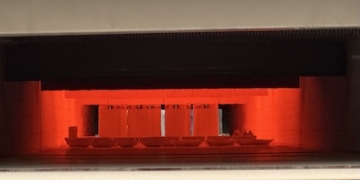
This expertise is based on a succession of industrial choices that are rarely visible to the end user. Wüsthof selects X50CrMoV15 steel. After forging, each blade undergoes a precise heat-treatment process that gives it a hardness of 58 HRC, providing a balance between edge retention and resistance to corrosion, wear and chipping, while ensuring that the blade remains easy to sharpen. Manufacturing then involves more than fifty operations and around twenty quality controls for the Classic series alone. During machining, a liquid-cooling system prevents the blade from overheating, which could otherwise cause microscopic cracks.
Sharpening relies on PEtec technology, which combines cameras and lasers to inspect each blade individually and guarantee a cutting angle of 14.5°. Production is largely automated, ensuring consistent quality across the 2.5 million knives manufactured each year, while every piece is still manually inspected before receiving the Made in Solingen label, guaranteeing that it has been manufactured entirely in the historic capital of German cutlery. Taken individually, each of these choices may seem relatively inconspicuous. Together, however, they define Wüsthof’s industrial signature and explain the consistent performance on which the reputation of its knives is built.
Finally, Nicolas Bisto points out that the value of a knife goes beyond technical performance: “In the end, you are not simply buying a knife that cuts. You are buying the pleasure of using it. The knife becomes an extension of the hand.” Wüsthof aims to convey this experience to retailers by combining technical knowledge with a passion for the product, enabling them in turn to showcase the collections more effectively to their customers.
Source : Home Fashion News #62 – Sept 2026 / Traduction : Leila Ahmad