- L’actualité B2B
- Tout
- Acquisition
- Actualités corporate
- Anniversaires
- Awards / récompenses
- Bureau / Office
- CHR/HORECA
- Communication / Marketing des entreprises
- Distribution
- e-commerce
- Etudes de marché
- Événements
- Industrie
- L'actu des salons professionnels
- L'actu Hôtellerie
- L'actualité des filières
- L'actualité RSE des entreprises
- Les grandes interviews
- Nominations
- Packaging
- Resultats financiers
- Retail - Actualité boutiques
- Retail - Actualité des grandes enseignes
- RSE / Économie circulaire
- Made in France
- HFN – Le Magazine
- International content

- L’actualité B2B
- Tout
- Acquisition
- Actualités corporate
- Anniversaires
- Awards / récompenses
- Bureau / Office
- CHR/HORECA
- Communication / Marketing des entreprises
- Distribution
- e-commerce
- Etudes de marché
- Événements
- Industrie
- L'actu des salons professionnels
- L'actu Hôtellerie
- L'actualité des filières
- L'actualité RSE des entreprises
- Les grandes interviews
- Nominations
- Packaging
- Resultats financiers
- Retail - Actualité boutiques
- Retail - Actualité des grandes enseignes
- RSE / Économie circulaire
- Made in France
- HFN – Le Magazine
- International content
DE’LONGHI × SIMON WEISSE : BEHIND THE SCENES OF THE WORLD’S SMALLEST COFFEE SHOPS
Presented during Milan Design Week 2026, De’Longhi’s The World’s Smallest Coffee Shop installation established itself as one of the event’s most talked-about attractions. Widely photographed and shared on social media by visitors, it quickly extended its reach far beyond Milan. A few weeks later, the campaign, created by De’Longhi with agency LOLA Madrid, was awarded the Grand Prix for Industry Craft and the Outdoor Gold Lion at Cannes Lions. We meet Simon Weisse, the master miniaturist who brought this extraordinary creation to life.
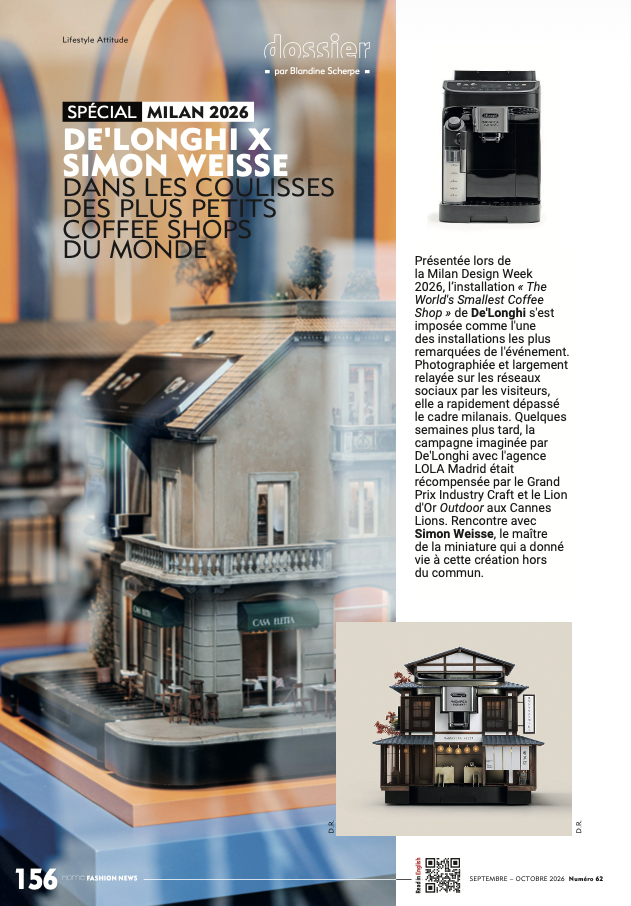
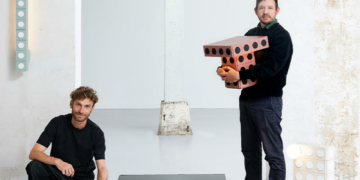
At first glance, it all seems almost unreal. A De’Longhi coffee machine becomes the façade of a Parisian coffee shop. A few centimetres away, a Milanese establishment appears ready to welcome its first customers. Further along, Tokyo, Berlin and Copenhagen come to life in miniature settings where every sign, every light and every pastry seems to tell a story. Behind these five miniature worlds is a man largely unknown to the general public, yet whose work has already travelled around the world. For more than thirty years, Simon Weisse has been building miniature sets for the film industry. His Berlin workshop has become one of the last places where an almost vanished craft is still practised: models made entirely by hand. Wes Anderson entrusted him with the sets for The Grand Budapest Hotel, and the miniatures that have shaped the director’s films ever since owe much to this instantly recognisable aesthetic. A constant pursuit of perfection, combined with an exceptional level of precision and attention to detail, naturally appealed to De’Longhi.
“I LEARNT EVERYTHING ON FILM SETS”
When Simon Weisse looks back on his career, he speaks more about encounters than about a career path. Nothing initially pointed towards his becoming one of the most sought-after miniature production designers in contemporary cinema. After studying Fine Arts in Montpellier, he was still unsure about his future. His father, a film-set photographer working in France and Germany, regularly took him along to shoots.“I had been immersed in cinema since I was very young. I did internships and small jobs. That’s how it all began,” he recalls.
The real turning point came on the set of Terry Gilliam’s The Adventures of Baron Munchausen at Cinecittà, near Rome. Thanks to his command of English, he joined the British special-effects team. At the time, visual effects were not yet created behind a computer screen. They took shape in workshops, where models, special props and sets were made by hand. Working under Richard Conway, an emblematic figure in special effects in Britain, Simon Weisse discovered a profession requiring remarkable versatility. “I learnt everything as I went along. You have to know how to draw, sculpt, work with wood and metal, understand mechanics… No one is really trained to build miniature sets for the film industry. The people working with me today come from all sorts of backgrounds.” For several years, he moved between productions in France, Germany and the United Kingdom. Among them was The City of Lost Children, where he continued to refine the craftsmanship that would eventually become his signature.
A CRAFT THAT DIGITAL TECHNOLOGY ALMOST MADE DISAPPEAR
The arrival of computer-generated imagery radically transformed production methods. The huge models that had once made studios famous gradually disappeared from film sets. “Today, 95% of visual effects are created on computers. We are part of a very small niche that continues to work the old-fashioned way,” explains Simon Weisse. Like many miniature specialists, he therefore redirected his work towards making special props. Miniature sets seemed destined to disappear altogether. Until the day when Babelsberg Studios, near Berlin, received a call from Wes Anderson, who was preparing The Grand Budapest Hotel and looking for someone capable of building genuine miniature sets. They immediately thought of Simon Weisse. “The meeting with the producer was very brief. We met and a few minutes later he simply said to me: ‘You got the job.’” That sentence marked the beginning of a collaboration that continues to this day. Since The Grand Budapest Hotel, Simon Weisse has become one of the craftspeople behind Wes Anderson’s visual universe. His Berlin workshop now brings its expertise to projects where miniatures have once again become a powerful vehicle for emotion. It is an expertise so rare that it is now sought after far beyond the film industry. His profession defies easy definitions. “I move between sets, props and visual effects. But above all, I am a production designer specialising in miniatures.”
WHEN DE’LONGHI KNOCKED ON HIS WORKSHOP DOOR
A few years later, Simon Weisse was contacted by LOLA Madrid, the agency responsible for devising De’Longhi’s new campaign. The idea was as original as it was ambitious: to transform coffee machines into miniature coffee shops inspired by major capitals including Paris, Milan, Berlin, Tokyo and Copenhagen. His first reaction, however, was to decline. “When I was told it was for an advertisement, I hesitated. In this profession, you are often called on Friday to shoot on Monday. But what they were asking for required weeks, even months, of work.”
The agency, however, had taken the time to study his work and anticipate his schedule. The project had been planned to give him the time required to pursue his exacting standards to the fullest. “They told us they wanted to go as far as possible in terms of refinement. From that moment on, the project became exciting. With my team, we realised we would be able to show our craft in a different way. Usually, our sets are filmed and then projected onto a cinema screen. This time, visitors were going to see them with their own eyes.”
For the first time, the set itself became the object that audiences came to see. It was a new experience for Simon Weisse and his team, opening a new chapter in their story.
THE WORKSHOP WHERE THE WORLD’S SMALLEST COFFEE SHOPS ARE BORN
As soon as Simon Weisse accepted the project, he understood that this was no ordinary advertising campaign. The idea sounded simple: turn five coffee machines into five coffee shops inspired by Paris, Milan, Berlin, Tokyo and Copenhagen. In practice, however, it raised a multitude of questions. “At the beginning, I admit, we were completely lost. We were used to creating models from a blank page. This time, we had to work with a coffee machine, build around it, give it depth, create the illusion of a genuine coffee shop while leaving the machine perfectly recognisable and, above all, fully operational.” The challenge was unprecedented. Unlike a film set designed to be filmed from a specific angle, the miniatures would be viewed from very close range. Visitors would be able to come within a few centimetres, inspect the windows, look at the signs and track down the smallest detail. No artifice would be possible. Usually, the studio’s work is seen through the lens of a camera. This time, the models would be directly exposed to the public’s gaze. Everything had to work in the real world.
In his Berlin workshop, Simon Weisse brought together a team of six or seven people. For several months, each worked on façades, shop windows, paving stones, lighting, signs, furniture and even miniature pastries. Every piece was made by hand before being weathered, adjusted and then incorporated into the overall composition. In total, more than 1,500 hours of work were required to bring the five coffee shops to life. From the very first weeks, a genuine dialogue developed between De’Longhi, the LOLA Madrid agency and the Berlin workshop. Rather than imposing a fixed vision, the brand and agency gave the craftspeople considerable freedom. The initial drawings evolved, some architectural features were completely redesigned during production, and ideas became richer as the project took shape. “We felt a genuine sense of trust. They let us create. That is what enabled us to achieve such a successful result.” For Simon Weisse, this freedom is inseparable from his perfectionism. “We are never satisfied. Right up to the last moment, we add another detail, redo a patina or correct a light. We are extreme perfectionists. Sometimes we tell ourselves it is almost excessive, but in the end you can always see it in the result.”
This constant pursuit goes far beyond simple technical virtuosity. Above all, it aims to create emotion. The initial sketches, sometimes developed with the help of artificial intelligence, opened up new creative possibilities by imagining bold architectural designs. But they still had to be translated into reality. “Some of the drawings were magnificent, but they did not take manufacturing constraints into account. We took those ideas, enriched them and worked on them until we found the right balance between the dream and what could actually be built.”
Artificial intelligence is therefore not a threat in his eyes. “Many people are afraid of it. I see it as a tool. We experienced exactly the same thing when 3D printers arrived. We were told that models would disappear. In the end, these technologies have become tremendous working tools. What will always make the difference is our experience, our creative eye and our craftsmanship.”
In his workshop, technology supports creation without ever replacing it. Every texture, every patina and every material effect continues to be worked by hand. It is precisely this combination of innovation, creative freedom and craftsmanship that gives the five miniature coffee shops their realism and evocative power. The perfectionism that drives his workshop also resonates with De’Longhi’s corporate culture. “They have achieved tremendous success, but they never rest on their laurels. They are constantly looking for ways to improve their products and take on new challenges. I recognise a great deal of myself in that mindset.”
WHEN ART BECOMES A BRAND LANGUAGE
Throughout his career, Simon Weisse has seen the expectations of major brands evolve. Advertising is no longer simply about highlighting a product’s qualities. It also seeks to tell a story, convey a culture and create emotion. “There was a time when advertising was primarily about selling a product. Today, brands want to share a vision, craftsmanship and a way of life. A coffee machine is not just about technology. It also tells a story about the art of living.” He observes the same evolution in his collaborations with major international houses. “Fortunately, brands such as Prada, Dior and Louis Vuitton call on artists to tell the story of their products differently. It is a way of recognising that art can bring something that a technical demonstration never could.”
This is precisely what appealed to Simon Weisse about De’Longhi’s project. The brand did not ask him to demonstrate the performance of its machines, but to bring the world of the coffee shop to life: to create an atmosphere, a light, a moment of conviviality — all the emotions associated with the pleasure of coffee. With The World’s Smallest Coffee Shop, technical expertise remains very much present, but it is expressed through an artistic creation that invites the public to experience something rather than simply watch a demonstration. Through their conversations, Simon Weisse also discovered a company with a deep commitment to creativity. He spontaneously mentions Braun, the iconic German industrial-design brand that is part of the De’Longhi Group. “Braun is not only remarkable technology. It also represents an exceptional design heritage. When De’Longhi takes over a brand like that, it also inherits a genuine culture of creativity. I find that fascinating.”
A STORY THAT CONTINUES TO TRAVEL
For Simon Weisse, the awards received at Cannes Lions are not the greatest achievement of The World’s Smallest Coffee Shop. What matters most to him is seeing the five miniature coffee shops continue their journey far beyond Milan Design Week.
After Milan, the installations are continuing to be exhibited. One of them has notably joined Harrods in London, while others are already scheduled to appear elsewhere. It is an unusually long life for an advertising campaign. “We often work for several months on a film. It comes out, then we move on to a completely different project. The story continues. People remember it.”
The experience reminds him of The Grand Budapest Hotel. Many people today know the hotel without necessarily having seen Wes Anderson’s film. Its architecture has become an instantly recognisable image. He now hopes to see the same thing happen with the five coffee shops imagined with De’Longhi: that they continue to travel and that, one day, the sight of one of these miniature façades will immediately bring the Italian brand to mind. Far more than an advertising campaign, The World’s Smallest Coffee Shop tells the story of an encounter between a company, a creative agency and a workshop of craftspeople united by the same pursuit of excellence. It also reflects a time when digital tools are playing an increasingly important role in creation, yet the eye, sensitivity and craftsmanship of women and men remain irreplaceable.
Source: Home Fashion News #62 – Sept 2026 / Translation: Leila Ahmad
![[LG]IFA2026_AI home_1](https://www.homefashionnews.fr/wp-content/uploads/2026/09/LGEIFA2026_AI-home_1-75x75.png)